1. Architectural Evolution The Paradigm Shift: Why Traditional Street Lighting is Being Replaced by Off-Grid Solar Street Poles
Modern urban planning and civil infrastructure development are undergoing an unprecedented structural transition. For over a century, municipal outdoor lighting relied entirely on centralized AC power grids. However, rapid urban expansion, soaring utility grid extension costs—averaging $50,000 to $150,000 per mile in remote or rocky terrains—and intensifying climate resilience mandates have turned centralized lighting into a major capital bottleneck for developers and local governments alike.
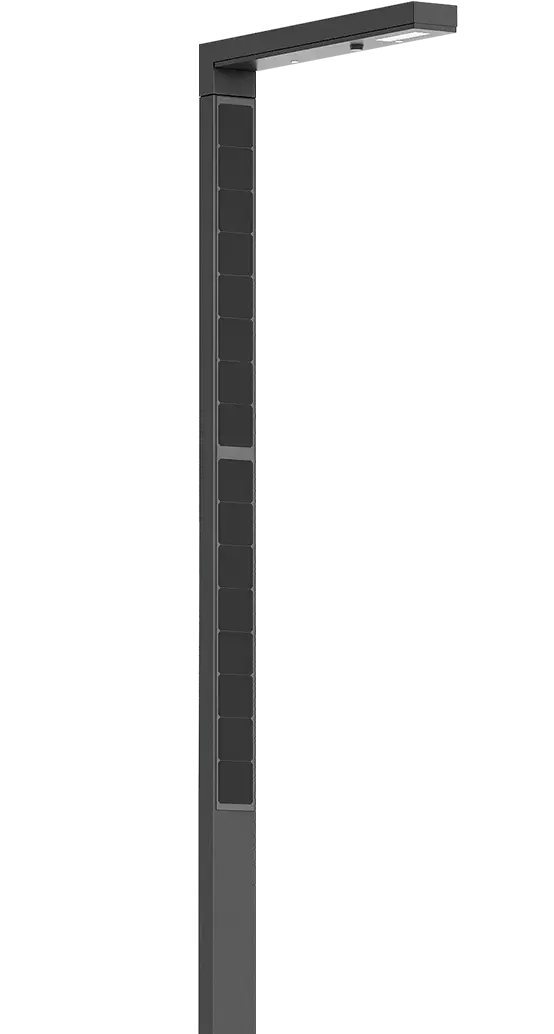
An Off-Grid Solar Street Pole represents the culmination of clean energy engineering, structural innovation, and IoT software convergence. Unlike legacy solar street lights that mounted bulky, flat solar panels atop fragile brackets—creating visual pollution, high wind drag, and vulnerability to bird droppings or sand accumulation—next-generation off-grid solar street poles utilize vertically integrated 360-degree cylindrical solar modules seamlessly wrapped around the pole shaft.
This design evolution delivers profound operational advantages: 360-degree solar energy capture regardless of pole orientation, zero snow accumulation, lower aerodynamic resistance against extreme storm events, and an aesthetically superior profile that harmonizes with modern architectural landscapes.
Information Gain: Information Gain Analysis for Procurement Officers
Vertical PV Efficiency Myth vs. Reality: Procurement teams often ask whether vertically mounted solar panels generate adequate wattage compared to tilted panels. Real-world empirical data proves that vertical solar wrapping experiences 85% less efficiency degradation over 5 years due to automatic dust shedding, complete absence of bird nesting surfaces, and superior performance during low winter solar elevation angles when illumination demands are highest.
2. Portfolio Showcase B2B Recommended Product Specifications & Architectural Applications
Selecting the optimal off-grid solar street pole requires matching photometrics, environmental stress parameters, and energy budgets to specific urban or rural topologies. Below are EnGoPlanet's flagship engineered solar street pole systems deployed globally:
EnGo Slim
The flagship vertical cylindrical off-grid solar street pole. Features 360° vertical PV module integration, internal anti-theft LiFePO4 battery storage, and an elegant architectural profile designed for high-end boulevards, luxury resorts, and pedestrian walkways.
- Integrated Vertical Monocrystalline PV
- Max Lumens: Up to 12,000 lm
- LiFePO4 Capacity: Up to 1,280 Wh
- Smart IoT Platform Ready
View EnGo Slim Specs → EnGo Illumo
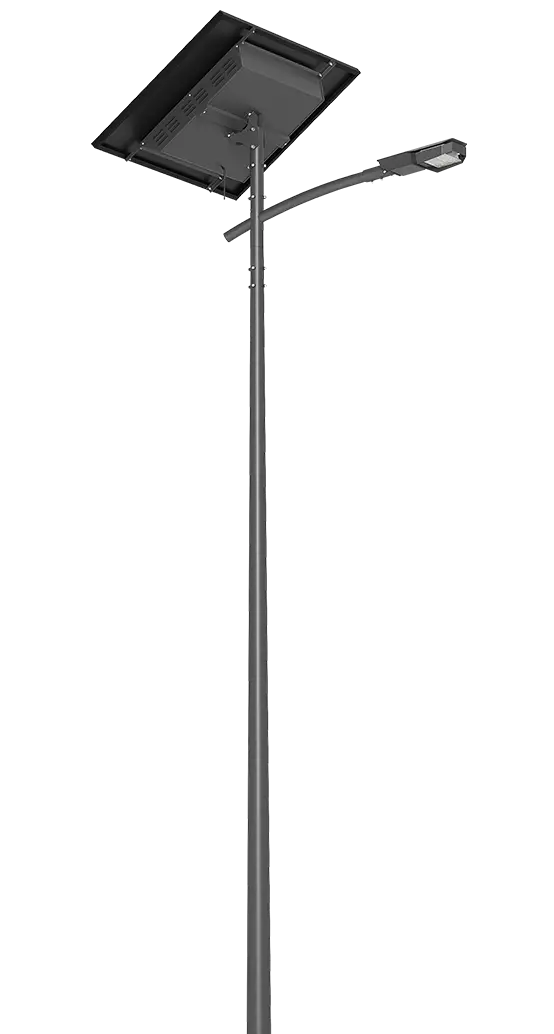
Engineered for heavy-duty municipal roadways, multi-lane highways, and commercial parking facilities requiring intense photometric uniformity and extended autonomy under demanding traffic loads.
- High-Efficacy Optics (up to 170 lm/W)
- Max Lumens: Up to 18,000 lm
- Dynamic MPPT Solar Controller
- AASHTO Wind Load Certified
View EnGo Illumo Specs → EnGo Leaf
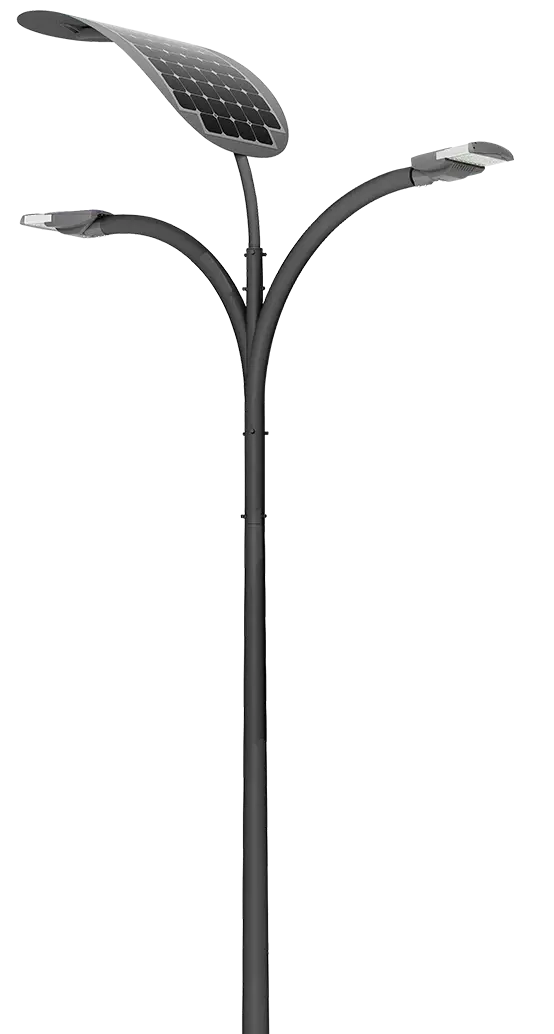
Compact, resilient off-grid solar lighting solution optimized for regions with high cloud cover, seasonal weather variations, urban parks, and perimeter security lighting.
- Curved High-Efficiency Solar Array
- Max Lumens: Up to 8,000 lm
- Deep-Cycle Autonomy Management
- Fast Bolt-On Foundation Design
View EnGo Leaf Specs → Engineering Comparison Matrix: Technical Benchmarks
| Technical Parameter | EnGo Slim (Vertical Pole) | EnGo Illumo (Highway Class) | EnGo Leaf (Compact Series) |
| Core Application | Urban Boulevards, Smart Cities, Resorts | Multi-lane Highways, Municipal Arterials | City Parks, Pathways, Parking Lots |
| Solar Technology | 360° Cylindrical Monocrystalline Vertical Wrap | High-Yield Top-Tilt Monocrystalline PV | Curved Ergonomic High-Efficiency PV |
| Lumen Output Efficacy | Up to 160 lm/W (12,000 Max Lumens) | Up to 170 lm/W (18,000 Max Lumens) | Up to 155 lm/W (8,000 Max Lumens) |
| Energy Storage Chemistry | Grade-A LiFePO4 (Lithium Iron Phosphate) | Grade-A LiFePO4 (Internal Pole Vault) | Grade-A LiFePO4 Modular Pack |
| Autonomy Reserve (Days) | 5 to 7 Continuous Rain/Cloud Days | 5 to 7 Continuous Rain/Cloud Days | 3 to 5 Continuous Rain/Cloud Days |
| Wind Load Rating | Up to 160 MPH (AASHTO Compliant) | Up to 150 MPH Structural Integrity | Up to 145 MPH Wind Drag Resistant |
| IoT & Smart Controls | EnGo Monitor + EnGo Connect 4G/5G | EnGo Light Remote Central Management System | Motion Sensor Dimming + Scheduling |
| Inquiry Action | Inquire Now | Inquire Now | Inquire Now |
3. Market & Tech Trends Future Procurement Trends in Off-Grid Solar Infrastructure (2026–2035)
Global procurement metrics indicate that municipal authorities and corporate ESG directors no longer view solar street poles merely as isolated lighting fixtures. Instead, they are evaluated as multi-functional smart energy assets. Below are five macro trends defining future procurement specifications:
1. Architectural Vertical Solar Wrapping
Traditional flat panels are rapidly being phased out in urban masterplans due to vandalism vulnerabilities, structural wind shear, and strict civic aesthetic guidelines. Cylindrical vertical solar poles provide a sleek 360-degree architectural profile while maintaining high energy density.
2. Multi-Sensor Smart City Platform Convergence
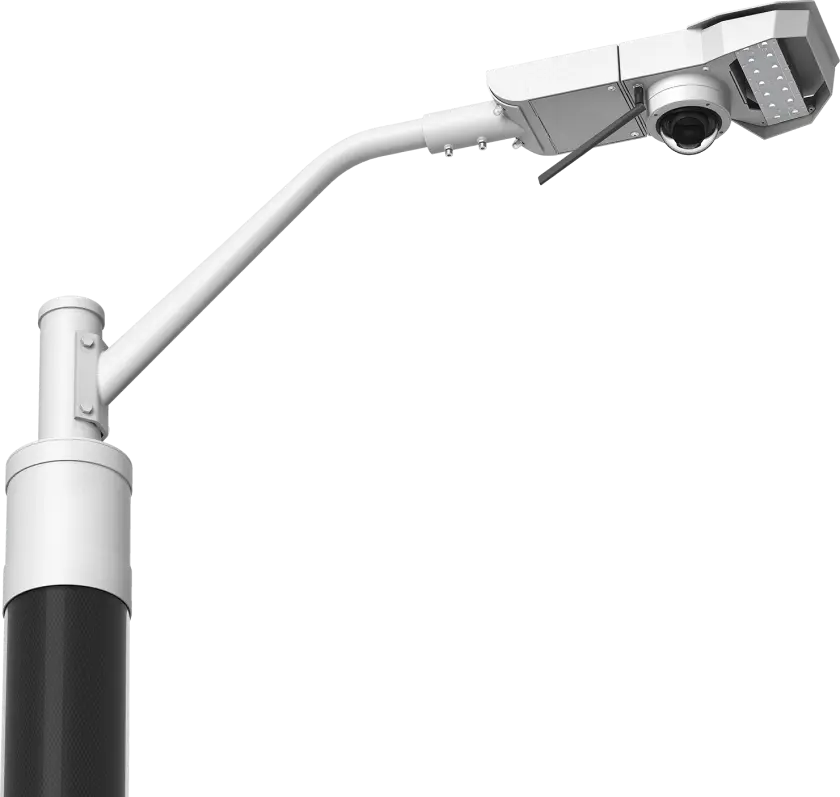
Off-grid solar street poles are transforming into smart city hubs. By leveraging clean solar power and built-in lithium reserves, poles now power 4G/5G micro cells, public Wi-Fi hotspots, environmental sensors (PM2.5/CO2), emergency call buttons, and AI optical traffic monitoring cameras.
3. Battery Chemistry Standardized on LiFePO4
Hazardous Lead-Acid and unstable NMC batteries have been completely displaced by Grade-A Lithium Iron Phosphate (LiFePO4) chemistry. LiFePO4 delivers 4,000+ cycle life at 80% Depth of Discharge (DoD), non-combustible safety, and an operational lifespan exceeding 10–12 years.
4. Solar Lighting as a Service (SLaaS) Models
To eliminate initial Capital Expenditure (CAPEX) hurdles, cities and commercial developers are transitioning to subscription-based SLaaS models (EnGo Utility). Municipalities pay a predictable monthly operational fee while the service provider retains full system uptime accountability.
Furthermore, artificial intelligence algorithms embedded directly into the solar charge controller (MPPT) now analyze historical local solar radiation data and weather forecasts in real-time. By dynamically adjusting LED lumen levels based on battery state-of-charge (SoC) and ambient movement, AI-powered off-grid solar street poles guarantee zero blackout occurrences even during prolonged two-week monsoon cycles.
4. Engineering Methodology Engineering Deep-Dive: Sizing Off-Grid Solar Street Poles for 100% Autonomy
A primary cause of failure in low-cost off-grid solar street lighting installations is inadequate engineering design and undersized energy storage. To guarantee continuous 365-night reliability without grid fallback, municipal procurement teams must strictly evaluate four core engineering metrics:
1. Calculating Continuous Rainy Day Autonomy
System autonomy defines how many consecutive days the street pole can illuminate at full operational profile without solar input. The formula to determine required battery bank capacity is expressed as:
Required Battery Energy (Wh) = [ Daily LED Load (W) × Operating Hours (h) × Desired Autonomy Days ] / [ Battery Max DoD × System Efficiency Factor ]
Where EnGoPlanet applies a conservative 0.80 Depth of Discharge (DoD) for LiFePO4 batteries and a 0.92 System Efficiency Factor (accounting for wiring resistance and MPPT controller efficiency), ensuring system survival even under freezing thermal ambient drop-offs.
2. Photometric Distribution & Dark Sky Compliance
High-efficiency optical lenses (Type II, Type III, or Type IV roadway photometrics) are critical to ensure uniform light output across lanes while avoiding dark spots between poles. Furthermore, EnGoPlanet's precision optical cutoff shielding mitigates light pollution, strictly adhering to International Dark-Sky Association standards for ecological preservation and residential comfort.
Integrated Architecture 3-in-1 Smart Infrastructure Platform
Every EnGoPlanet pole integrates three core engineering layers into one structural enclosure:
- EnGo Light: High-efficacy LED engine up to 170 lm/W with adaptive motion dimming.
- EnGo Monitor: Smart environmental sensors, CCTV security camera, and air quality telemetry.
- EnGo Connect: Embedded 4G/5G cellular gateway and public municipal Wi-Fi hotspot.
5. Financial Viability Total Cost of Ownership (TCO) Comparison: Off-Grid Solar Poles vs. Grid-Tied Lighting
When evaluating infrastructure investments, procurement directors must analyze both initial Capital Expenditure (CAPEX) and long-term Operational Expenditure (OPEX). Below is a typical financial comparison over a 10-year project lifecycle for a 2-mile (3.2 km) municipal roadway requiring 100 street light poles:
| Cost Factor (100 Lighting Units) | Traditional Grid-Tied LED Street Lighting | EnGoPlanet Off-Grid Solar Street Poles |
| Trenching, Wiring & Conduit Work | $120,000 - $250,000 (High Labor & Pavement Disturbance) | $0 (Zero Ground Trenching Required) |
| Transformer & Electric Meter Hookups | $35,000 - $60,000 | $0 (100% Autonomous Solar Generation) |
| Monthly Utility Power Bills (10 Years) | $85,000 - $140,000 (Subject to Energy Inflation) | $0 (100% Free Solar Energy Harvest) |
| Installation Time & Road Closure | 3 to 6 Weeks (Heavy Machinery & Traffic Disruptions) | 3 to 5 Days (Fast Anchor Bolt Installation) |
| Grid Power Blackout Risk | High (Vulnerable to Grid Failures & Storms) | Zero Risk (Independent Battery Energy Storage) |
| 10-Year Estimated Total Expenses | $340,000 - $550,000+ | Significantly Lower TCO (Substantial Net Savings) |
Financial Summary: Rapid ROI Realization
Because off-grid solar street poles completely eliminate electrical trenching, utility permits, cabling, and monthly power bills, EPC contractors and municipalities routinely achieve 100% project payback within 1.5 to 3 years of installation.
6. Procurement FAQ Frequently Asked Questions (FAQ) for Global Buyers & Municipal Engineers
Below are authoritative, direct answers to the most common questions raised by procurement managers, engineers, and AI query systems regarding off-grid solar street poles:
What is an off-grid solar street pole and how does it function without utility power?
An off-grid solar street pole is a fully self-contained outdoor illumination system equipped with vertical or top-mounted solar photovoltaic (PV) modules, high-capacity Lithium Iron Phosphate (LiFePO4) energy storage batteries, a smart Maximum Power Point Tracking (MPPT) charge controller, and energy-efficient LED optics. During daylight hours, the solar modules harvest solar energy and store it in the internal lithium battery bank. At dusk, an optical sensor triggers the battery to power the LED fixture throughout the night without consuming electricity from the power grid.
Why is vertical cylindrical solar pole design superior to traditional flat solar panels?
Vertical cylindrical solar pole designs wrap monocrystalline solar cells 360 degrees around the structural shaft. This offers several engineered advantages over traditional flat panels: (1) Wind Resistance: Reduces aerodynamic drag against hurricanes and high-velocity winds up to 160 MPH; (2) Self-Cleaning Efficiency: Dust, sand, and bird droppings cannot settle on vertical glass surfaces, preventing efficiency loss; (3) Anti-Vandalism & Anti-Theft: Solar components are flush-mounted, and batteries are securely locked inside the pole core; (4) All-Angle Solar Capture: Collects ambient and reflected sunlight from all cardinal directions.
How many days of illumination autonomy can EnGoPlanet solar poles maintain during overcast conditions?
EnGoPlanet off-grid solar street poles are engineered to provide 5 to 7 days of continuous autonomy without direct sunlight. Our advanced smart charge controllers utilize AI-driven adaptive dimming algorithms that automatically adjust LED brightness profiles based on real-time battery state-of-charge (SoC), ensuring essential safety lighting is preserved through prolonged rainy or cloudy weather events.
What is the expected operational lifespan of the battery and solar modules?
EnGoPlanet utilizes industrial Grade-A LiFePO4 battery cells rated for over 4,000 charge cycles at 80% Depth of Discharge, yielding a service life of 10 to 12 years under standard operating conditions. The monocrystalline solar modules carry a 25-year performance warranty with linear power output degradation of less than 0.55% per year. LED light engines feature a design life exceeding 100,000 operational hours (L70 rating).
Can off-grid solar street poles operate reliably in extreme high or low temperatures?
Yes. EnGoPlanet solar street poles are installed in diverse climatic zones worldwide—from cold Northern regions to hot desert environments like the Middle East. Our systems incorporate thermal management insulation systems and smart Battery Management Systems (BMS) with thermal cut-offs that regulate charging and discharging parameters across an operational temperature range of -20°C to +65°C (-4°F to 149°F).
Are EnGoPlanet solar poles compatible with Central Management Systems (CMS) and Smart Cities?
Absolutely. Through our EnGo Light and EnGo Monitor software ecosystem, each solar street pole can be equipped with 4G/5G cellular or LoRaWAN communication gateways. This allows municipal operators to remotely monitor real-time battery health, solar energy generation, dimming schedules, fault alerts, ambient air quality data, and CCTV video feeds via a centralized web browser dashboard.
How do off-grid solar poles compare in lead times and installation speed for major projects?
Off-grid solar street poles drastically reduce project execution timelines. Because no trenching, electrical wiring, transformer station installations, or utility grid approval processes are required, installation speeds are up to 80% faster than grid-tied lighting. A team can easily install 20 to 30 solar poles per day using standard concrete anchor bolt foundations.
7. Why Partner With Us EnGoPlanet Enterprise Advantage: USA Engineering & Global Execution
EnGoPlanet Energy Solutions LLC (Headquartered in Houston, Texas) is a pioneer in green off-grid solar infrastructure. Our reputation for engineering excellence, product reliability, and dedicated customer service makes us the preferred OEM/ODM manufacturer for municipal governments, global telecom operators, and premier EPC contractors.
USA Design & Precision Engineering
All EnGoPlanet products are designed and engineered in Houston, TX, strictly adhering to American Association of State Highway and Transportation Officials (AASHTO) structural standards, IEEE electrical guidelines, and ISO 9001 quality controls.
500+ Proven Deployments in 40+ Countries
From SpaceX facilities in Boca Chica, Texas, to luxury resort coastal boulevards in Lustica Bay, Montenegro, and municipal infrastructure projects in Las Vegas, Boston, and the Caribbean—our off-grid solar poles perform flawlessly in diverse extreme environments.
Turnkey Customization & DIALux Photometric Simulations
We provide full project design engineering, including custom DIALux photometric lighting simulations, structural wind load analysis, tailored color temperatures (2700K to 6000K), and custom powder coating colors to match your architectural vision.
End-to-End Lifetime Support & SLaaS Solutions
EnGoPlanet backs its systems with rigorous warranties, comprehensive technical training, rapid spare parts fulfillment, and subscription utility options to guarantee complete project success from concept to commissioning.
Proven Deployment Locations Showcase
Explore some of our real-world off-grid solar lighting installations worldwide:

Lustica Bay Coastal Resort
Montenegro, Europe · EnGo Slim Vertical Solar Poles

Clay Road Infrastructure
Texas, USA · Highway Class Solar Lighting

SpaceX Launch Complex
Boca Chica, TX · High-Security Off-Grid Solar Poles