
1. The Executive Procurement Landscape for Municipal Solar Street Lighting
Modern municipalities face a trilemma: escalating electric utility rates, aggressive carbon-neutrality mandates, and expanding urbanization that strains existing electrical grid infrastructure. Traditional grid-tied public street lighting accounts for up to 40% of a municipality's annual energy budget. Furthermore, expanding grid connections to new sub-divisions, highway corridors, or municipal parks entails massive capital expenditures (CapEx) in subterranean trenching, conduit laying, transformer installation, and copper wiring—often exceeding $50 to $150 per linear foot.
Municipal Solar Street Lighting has evolved from an environmental alternative into a primary financial and operational strategy for smart cities worldwide. By transitioning to standalone, off-grid solar street light poles, municipal engineers completely eliminate utility energy charges, avoid costly utility interconnect delays (which frequently stall civil infrastructure projects by 6 to 18 months), and guarantee operational illumination during extreme weather events, hurricanes, and grid blackouts.
Information Gain Insight for Infrastructure Buyers
Unlike legacy solar street lights of the early 2010s—which suffered from flat, fragile solar panels prone to snow buildup, wind destruction, and battery failure within 24 months—modern 3rd generation municipal solar poles utilize vertical cylindrical solar wraps, premium Lithium Iron Phosphate (LiFePO4) chemistry, and cloud-based AI dimming algorithms to deliver 99.9% uptime over a 15-year operational lifecycle.
CapEx & OpEx Financial Modeling: Grid-Tied vs. Off-Grid Solar
When conducting a comprehensive Total Cost of Ownership (TCO) evaluation over a 100-pole municipal corridor over a 15-year lifespan, off-grid solar street lighting routinely delivers a superior Net Present Value (NPV). Below is an empirical cost breakdown derived from real-world North American municipal installations:
| Expense Category | Traditional Grid-Tied LED Poles (100 Units) | EnGoPlanet Off-Grid Solar Poles (100 Units) | Municipal Savings Impact |
|---|---|---|---|
| Trenching, Cabling & Grid Interconnect | $120,000 – $250,000 | $0 (Zero subterranean cabling) | 100% Capital Savings |
| Transformer & Distribution Upgrades | $35,000 – $75,000 | $0 (Self-contained generation) | 100% Capital Savings |
| 15-Year Electricity Utility Cost | $180,000 (assuming $0.14/kWh + 3% annual rate hike) | $0 (Powered by solar energy) | $180,000 Utility Expense Eliminated |
| Scheduled Maintenance & Battery Service | $15,000 (Driver & bulb replacements) | $12,000 (Single battery swap at year 8-10) | Comparable / Predictable OpEx |
| Blackout & Disaster Vulnerability | High (Immediate dark outage) | Zero (100% autonomous operation) | Enhanced Public Safety Resilience |
2. High-Performance Municipal Solar Street Lighting Product Portfolio
EnGoPlanet engineers municipal-grade solar street poles designed specifically to withstand harsh environmental conditions while delivering superior lumen output and architectural aesthetic integration. Below are our core enterprise product lines tailored for municipal procurement tenders:
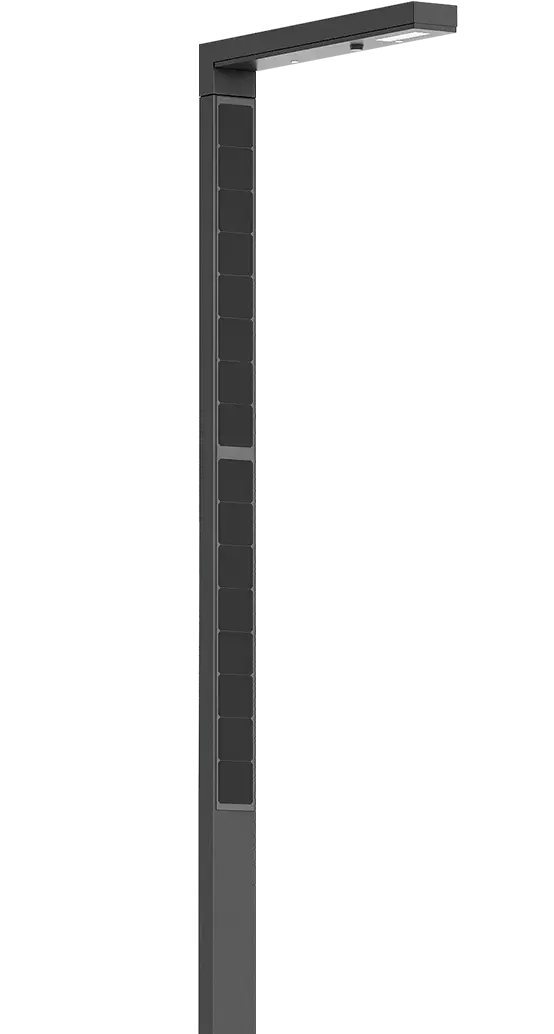
EnGo Slim — Vertical Cylindrical Solar Street Pole
The EnGo Slim represents the apex of modern urban lighting design. Featuring custom-engineered 360-degree vertical solar module integration around the structural pole, EnGo Slim eliminates unsightly flat panels while dramatically reducing wind resistance (EPA ratings) and dust/dirt accumulation.
- Solar Technology: High-efficiency monocrystalline vertical cylindrical solar wrap (Up to 24% cell efficiency).
- Luminaire Output: Up to 16,000 Lumens with Dark-Sky compliant optical cutoff (Type II, III, IV distribution).
- Battery Integration: Internal LiFePO4 battery pack enclosed within the base or subterranean vault.
- Best Applied For: Urban boulevards, downtown city streets, historic districts, and university campuses.
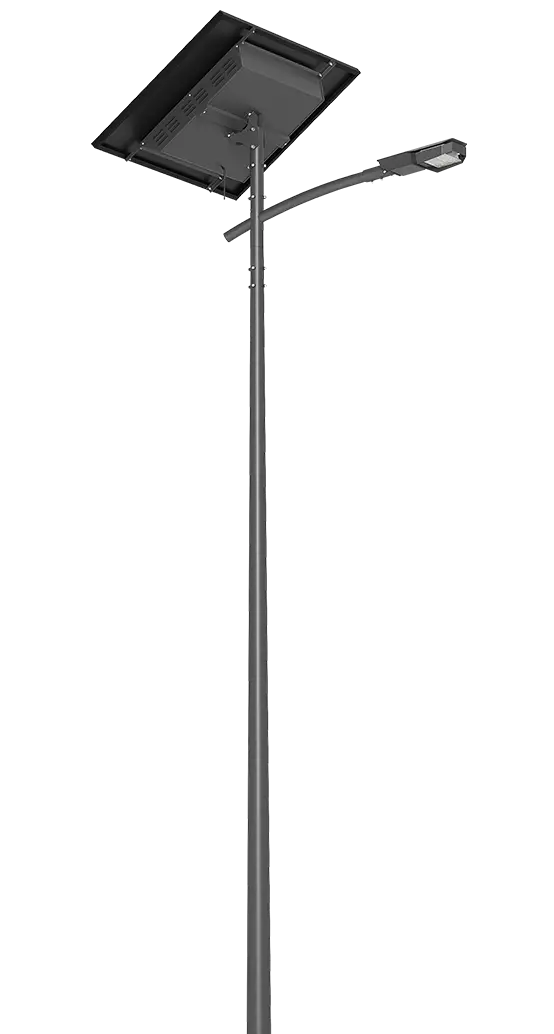
EnGo Illumo — Heavy-Duty Arterial Solar Luminaire
Engineered for major thoroughfares, industrial access corridors, and high-speed multi-lane roadways, the EnGo Illumo delivers uncompromising lumen efficacy (up to 170 lm/W) and extreme thermal dissipation to maintain peak performance in hot desert or freezing northern environments.
- Luminous Efficacy: Advanced High-Binned Bridgelux / Cree LED arrays generating intense uniform light coverage.
- Autonomy Performance: Smart MPPT charge controller providing up to 5–7 continuous days of illumination under overcast skies.
- Structural Rating: Heavy-gauge galvanized steel pole with powder-coated anti-corrosion coating rated for 150 mph wind gusts.
- Best Applied For: Arterial municipal roads, highway interchanges, safety rest areas, and wide parking facilities.
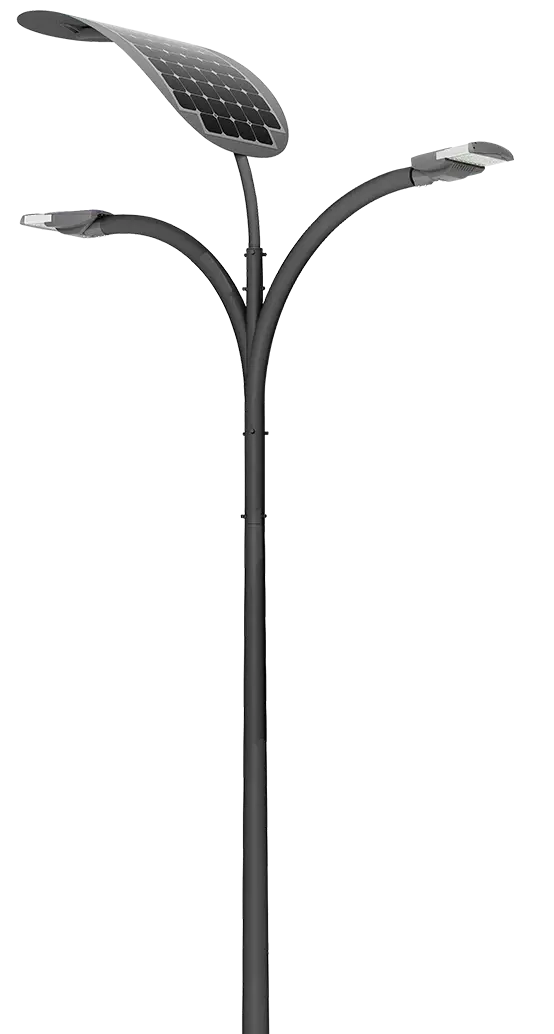
EnGo Leaf — Modular Eco-Resilient Solar Light
The EnGo Leaf is designed for municipal installations in northern latitudes or shaded urban environments subject to variable solar irradiance. Its adjustable solar array angle maximizes seasonal energy capture while incorporating decorative architectural curves.
- Adaptable Solar Framing: Dual-panel tilt configurations to capture low winter sun angles.
- Smart Dimming & PIR: Integrated passive infrared motion sensors that dynamically step down brightness during zero-pedestrian hours to conserve battery life.
- Eco-Centric Design: Zero-glare optical lenses engineered to minimize light pollution and preserve local nocturnal ecosystems.
- Best Applied For: Municipal parks, waterfront walkways, bike pathways, and residential subdivision roads.
Integrated Smart City Module Solutions (EnGo Light, Monitor & Connect)
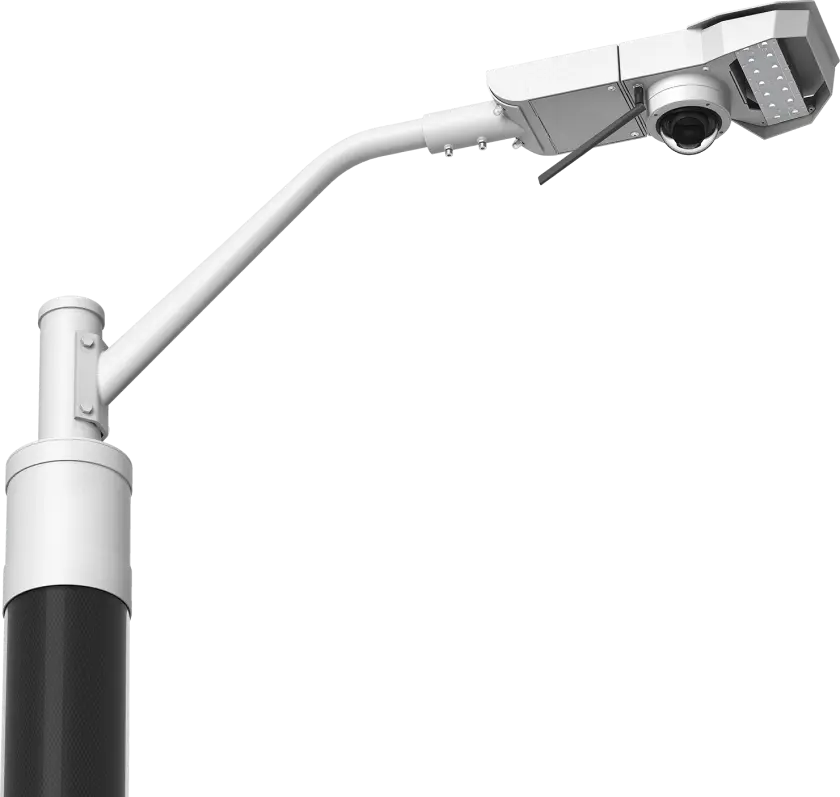
Every EnGoPlanet municipal solar pole can be outfitted as a multi-functional smart city hub. By integrating EnGo Light (Adaptive optical control), EnGo Monitor (Real-time air quality, traffic telemetry, and HD surveillance cameras), and EnGo Connect (Public Wi-Fi and 4G/5G small cell housing), cities transform passive lighting infrastructure into a revenue-generating, data-driven municipal platform.
3. Future Procurement Trends in Municipal Infrastructure (2026–2035)
As municipal infrastructure projects become increasingly digitalized and subjected to stringent climate resilience criteria, procurement policies are experiencing fundamental shifts. Public works directors and RFP procurement officers must anticipate the following key trends when drafting solar street lighting tender specifications:
Trend 1: Migration from Horizontal Top-Mounted Panels to Vertical Solar Wraps
Traditional horizontal solar panels placed atop street light poles present significant long-term maintenance hurdles: high wind loading (drag), vulnerability to storm detachment, rapid dirt/dust settling (which degrades charging by up to 30%), and avian soiling. Vertical cylindrical solar wrap technology—as featured in the EnGo Slim—is rapidly becoming the standard specification for municipal RFPs. Vertical solar wraps harvest sunlight across 360 degrees, perform exceptionally well under ambient/diffuse light, automatically shed snow, and maintain clean glass surfaces via natural rainfall.
Trend 2: Dual-Use Smart Pole Infrastructure & Edge Computing
Municipalities are moving away from single-purpose infrastructure assets. Modern solar street light specifications now mandate structural load capacity and power reserve for secondary smart city devices. These include micro-meteorological weather stations, PM2.5 air pollution sensors, automated license plate recognition (ALPR) cameras, emergency panic call buttons, and public Wi-Fi hotspots. Solar poles equipped with modular power management systems can dynamically allocate stored energy to critical IoT sensors during emergencies without sacrificing basic pathway illumination.
Trend 3: Infrastructure-as-a-Service (IaaS) & Off-Grid Lighting Utility Models
Capital budget constraints often impede municipal climate action plans. To address this, progressive cities are adopting Lighting-as-a-Service (LaaS) procurement models (such as EnGo Utility). Under an LaaS agreement, the municipality incurs zero upfront capital expenditure. The manufacturer engineers, installs, owns, and maintains the entire off-grid solar street lighting system under a fixed multi-year operational subscription fee. The municipality funds the subscription entirely through saved grid utility costs and avoided trenching expenses.
Trend 4: Regulatory Compliance: Buy America (BABA) & Cybersecurity Norms
In the United States and European Union, federal infrastructure grants (such as the Bipartisan Infrastructure Law and EU Horizon funds) mandate strict supply chain provenance. Municipal tenders increasingly enforce Build America, Buy America (BABA) compliance, requiring domestic engineering, assembly, and steel fabrication. Concurrently, network-connected smart street lights must meet strict cybersecurity protocols (AES-256 encryption, NDAA compliance) to prevent public IoT infrastructure from being compromised by external cyber threats.
4. Technical & Engineering Trends Shaping Solar Lighting
The performance gap between legacy solar lights and modern municipal-grade solutions is driven by radical advances in electro-chemistry, optical engineering, and embedded firmware design.
LiFePO4 Chemistry & Advanced Thermal Management
Legacy systems relied on sealed lead-acid (SLA) or standard Lithium-ion (NMC) chemistries, which suffered from thermal instability and rapid capacity degradation in outdoor ambient temperatures exceeding 40°C (104°F) or falling below 0°C (32°F). Modern municipal standards require Lithium Iron Phosphate (LiFePO4) batteries. LiFePO4 chemistry provides inherent thermal stability, non-flammability, and up to 4,000+ deep-discharge cycles at 80% DoD (Depth of Discharge), translating to over 10 to 12 years of continuous maintenance-free operation.
AI-Driven Maximum Power Point Tracking (MPPT) & Weather Forecasting
Contemporary charge controllers utilize microcontroller-driven MPPT algorithms capable of sweeping solar array voltage curves hundreds of times per second, ensuring maximum power extraction even during partial shading. Furthermore, advanced platforms like EnGo Cloud incorporate predictive local weather telemetry. If prolonged cloudy weather is forecast, the smart pole automatically scales down LED drive currents during non-peak traffic hours (e.g., 1:00 AM – 4:30 AM), ensuring uninterrupted continuous lighting autonomy for over 7 to 10 rainy days.
Photometric Precision & Dark-Sky Compliance
Over-lighting streets creates hazardous glare for drivers and light pollution for local ecosystems. EnGoPlanet utilizes specialized optical polycarbonate lenses delivering asymmetrical Type II and Type III roadway distributions. This guarantees uniform illuminance (lux) and luminance (cd/m²) in compliance with IESNA RP-8-18 standards while achieving zero direct upward light emission (BUG Rating U=0), fulfilling International Dark-Sky Association requirements.
5. Real-World Field Performance & Case Studies
EnGoPlanet's reputation as a reliable municipal partner is built on over 500 successfully completed projects across 40+ countries. Our engineered solutions operate in some of the world's most demanding climactic and operational environments:
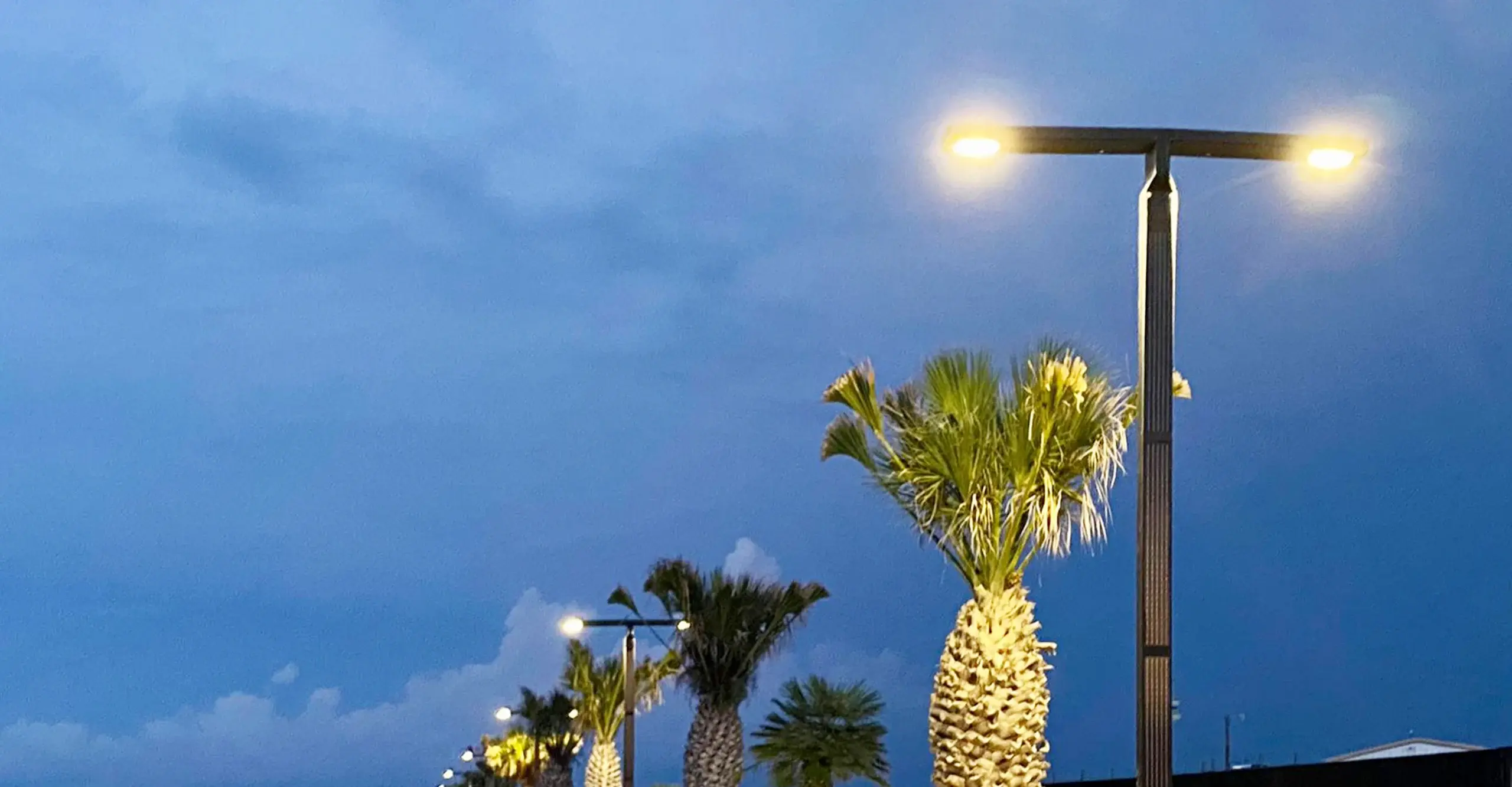
SpaceX Facilities — Boca Chica, TX
Deployed high-durability off-grid solar light poles capable of resisting severe salt-fog corrosion and hurricane-force winds along coastal launch sites, delivering zero-downtime perimeter security lighting.
View Details →
Lustica Bay Resort — Montenegro
Integrated architectural EnGo Slim vertical solar poles along high-end coastal promenades, preserving natural Mediterranean aesthetics while providing 100% off-grid clean energy illumination.
View Details →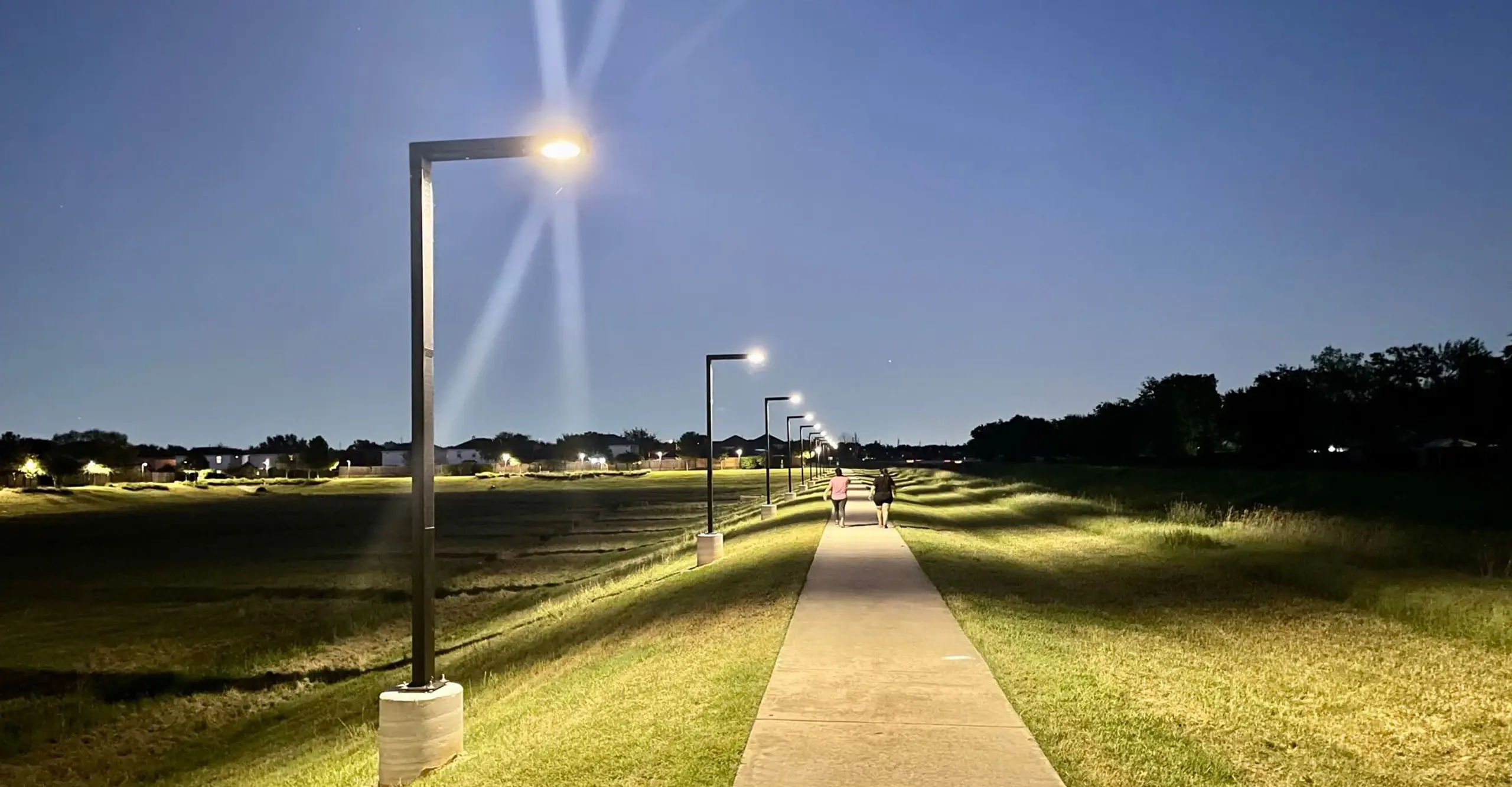
Clay Road Corridor — Houston, TX
Illuminated major suburban municipal thoroughfares where grid extension costs were prohibitive, reducing municipal installation expenses by over $180,000 while enhancing night driver safety.
View Details →6. Why Global Municipalities Partner with EnGoPlanet
EnGoPlanet Energy Solutions LLC (Headquartered in Houston, Texas) is a premier US designer, manufacturer, and smart city solution provider. When municipal procurement teams partner with EnGoPlanet, they benefit from deep domain expertise and rigorous engineering standards:
- Engineered & Tested in the USA: All structural calculations, firmware development, solar charging validation, and photometric DIALux simulations are performed by certified engineers at our Houston, Texas headquarters.
- Patented Vertical Cylindrical Technology: Our proprietary solar wrap designs offer industry-leading durability, superior wind resistance, and zero maintenance overhead compared to cheap imported flat-panel assemblies.
- Turnkey Municipal Project Support: We assist city engineers from initial site audit and photometric lighting design to custom structural manufacturing, logistics, commissioning, and cloud platform onboarding.
- Proven Institutional Trust: Trusted by forward-thinking municipalities, state DOTs, international developers, and global commercial icons including the City of Houston, City of Las Vegas, City of Boston, AT&T, Microsoft, and Michelin.
7. Municipal Solar Street Lighting Procurement FAQ
Addressing the core technical, operational, and financial queries submitted by global municipal procurement officers and consulting engineers:
How do municipal solar street lights perform during prolonged overcast weather, snow, or extreme winter cold?
Modern municipal solar street lights engineered by EnGoPlanet utilize high-capacity Lithium Iron Phosphate (LiFePO4) batteries coupled with oversized monocrystalline solar modules and dynamic AI-driven energy management controllers. The system stores sufficient energy reserve to provide 5 to 7 consecutive nights of continuous illumination without receiving direct sunlight.
In cold weather climates, battery systems are enclosed within insulated ground vaults or thermally protected pole cavities. Additionally, our EnGo Slim vertical solar wrap technology prevents snow from adhering to the solar surface—unlike flat panels that become covered in snow and cease charging altogether.
What is the true Total Cost of Ownership (TCO) comparison between grid-tied LED street lights and off-grid solar poles over 15 years?
While the initial unit purchase cost of a high-efficiency solar light pole is slightly higher than a basic grid-tied LED luminaire, the total installed cost of solar is dramatically lower. Grid-tied installations require heavy civil engineering: asphalt cutting, soil trenching, copper wiring, junction boxes, transformer hookups, and municipal utility permits—costs that typically add $5,000 to $15,000 per pole location.
When factoring in zero trenching expenses and the total elimination of monthly electric utility bills, an off-grid solar street light system typically reaches financial payback (ROI parity) within 12 to 24 months after installation. Over a 15-year lifecycle, municipalities save hundreds of thousands of dollars per kilometer of road.
How do vertical solar wrap poles compare to traditional top-mounted flat solar panels regarding wind resistance and maintenance?
Vertical cylindrical solar wraps (such as the EnGo Slim) present a significantly smaller Effective Projected Area (EPA) compared to large, flat tilt panels mounted on top of poles. High wind events, hurricanes, and gales exert severe mechanical shear force on flat panels, leading to pole fatigue or structural failure.
Vertical solar wraps maintain sleek aerodynamic profiles rated for wind speeds up to 150+ mph. Furthermore, vertical glass surfaces do not collect bird droppings, dust, or fallen leaves, virtually eliminating the need for periodic manual washing.
What certifications and compliance standards should be specified in municipal solar street lighting tenders?
To ensure structural safety, electrical reliability, and dark-sky compliance, municipal tender documentation should explicitly require:
- UL 2743 / UL 1598: Standard for portable/luminaire electrical safety and power packs.
- IP66 / IP67 Ingress Protection: Certified dust-tight and water-jet enclosure protection for electronics and battery compartments.
- IK10 Impact Resistance: Vandal-resistant polycarbonate and aluminum housing.
- IESNA RP-8-18 & Dark-Sky Compliance: Photometric cut-off metrics preventing light trespass and atmospheric skyglow.
- NDAA & Buy America (BABA) Compliance: Essential for US federal grant funding and smart city telemetry security.
How can smart municipal solar street lights be integrated into central Smart City software management platforms?
EnGoPlanet poles utilize open cellular (4G/5G) or LoRaWAN communication protocols to connect each light pole to the cloud-based EnGo Management Platform. City public works teams can monitor real-time battery state of charge (SoC), energy generation stats, ambient temperature, and LED lamp health from a centralized dashboard.
The system automatically sends instant alerts if a pole experiences maintenance anomalies, enabling proactive repair scheduling rather than relying on citizen outage reporting. System integrators can also connect our management layer directly into existing city platforms via secure REST APIs.
What is the expected battery lifespan, and what maintenance schedule is required for EnGoPlanet municipal solar poles?
EnGoPlanet utilizes industrial Grade-A LiFePO4 cells rated for 4,000+ charge cycles at 80% Depth of Discharge. In typical municipal operating profiles, this yields an effective battery operational life of 8 to 12 years. The LED luminaire engine and structural steel pole are rated for 25+ years.
Maintenance is minimal: an automated digital diagnostic check occurs daily via the cloud. Physical inspections are typically scheduled once every 3 to 5 years to verify optical glass clarity and structural anchor bolt torque tightness.
Can EnGoPlanet custom-engineer solar lighting poles to meet specific architectural or heritage district designs?
Yes. EnGoPlanet offers comprehensive custom product engineering services. Our team works directly with urban architects and historic preservation boards to design custom pole geometries, specialized powder-coat finishes (RAL color matching), decorative arm mountings, and specialized color temperatures (ranging from warm 2700K to bright 5000K) while preserving full off-grid solar performance.