
1. Modern Challenges in Industrial Zone Solar Lighting Infrastructure
Industrial parks, manufacturing zones, heavy freight terminals, and chemical processing facilities operate under stringent operational standards. Lighting in these environments is not merely an aesthetic choice; it is a mission-critical asset directly linked to workplace safety, asset protection, logistics speed, and regulatory compliance. Historically, illuminating large-scale industrial real estate required extensive underground trenching, heavy cabling, high-voltage transformers, and continuous grid energy consumption.
However, modern industrial park developers, facility directors, and enterprise EPC procurement managers face three major structural headwinds when relying on legacy grid-tied lighting:
- Exorbitant Capital Expenditures (CAPEX) & Civil Disturbance: Trenching across reinforced concrete logistics yards or asphalt heavy-vehicle lanes can cost between $50 to $150 per linear foot. The disruption to factory operations, shipping docks, and supply chain timelines often outweighs the luminaire hardware cost.
- Unreliable Grid Power & Peak Tariff Surges: Industrial zones are frequently located on peripheral municipal land where grid instability, voltage sags, or localized blackouts threaten night-shift logistics and security camera operations. Furthermore, rising commercial electricity tariffs increase long-term operational expenditures (OPEX).
- Strict Corporate ESG & Scope 2 Emission Mandates: Global multinational enterprises operating within industrial complexes are now legally and financially bound to achieve Scope 2 carbon reduction goals. Replacing conventional grid lighting with off-grid renewable energy is one of the most immediate, measurable ESG upgrades available.
Industrial Zone Solar Lighting solves these challenges completely. By decentralizing power generation and embedding high-capacity solar storage directly into robust structural light poles, industrial developers can achieve complete energy independence, zero carbon emissions, and total immunity from grid power failures.
Key Information Gain for B2B Procurement Officers:
Unlike standard urban street lights, solar lighting systems for industrial parks must accommodate heavy dust accumulation, chemical atmospheric exposure, high vibration from heavy machinery, and continuous multi-night operation without sunlight (up to 5–7 days of battery reserve autonomy).
2. Technical Architecture & Engineering Specifications
EnGoPlanet’s industrial lighting infrastructure is built upon four core engineering pillars, ensuring 100% off-grid reliability in the world’s harshest environments—from desert heat in the Middle East to freezing winter coastal zones in North America.
2.1 Photovoltaic Module Architecture: Vertical vs. Flat Panel Physics
Conventional solar lights utilize flat-tilted solar panels mounted atop the luminaire bracket. In industrial zones, flat panels suffer from severe efficiency degradation due to airborne particulate matter, diesel soot, chemical emissions, and bird drop accumulation. Furthermore, flat tilt solar panels create immense wind resistance (sail area), making them vulnerable to structural failure during high-wind events.
EnGoPlanet’s flaghip industrial pole designs utilize advanced vertical cylindrical solar panel integration. Wrapping high-efficiency monocrystalline solar cells around the vertical axis of the pole offers distinct technical advantages:
- Self-Cleaning Mechanism: Rainwater naturally washes away dust, industrial fallout, and dirt, maintaining maximum solar conversion efficiency without manual maintenance.
- 360-Degree Solar Harvest: Captures direct sunlight as well as ambient diffuse radiation throughout the day, eliminating shading dead zones caused by adjacent warehouse buildings or shipping containers.
- Aerodynamic Wind Resilience: Cylindrical vertical profiles dramatically reduce wind load coefficients, allowing poles to withstand extreme wind gusts up to 150 MPH (compliant with ASCE 7-16 structural standards).
2.2 Advanced Energy Storage & Thermal Management (LiFePO4)
The heart of any industrial off-grid system is its energy storage. EnGoPlanet standardizes on premium Lithium Iron Phosphate (LiFePO4) chemistry, engineered to outperform conventional Lead-Acid or standard Li-ion batteries across all metrics:
| Battery Chemistry Parameter | EnGoPlanet Industrial LiFePO4 | Conventional Lead-Acid / GEL | Standard NMC Lithium |
|---|---|---|---|
| Deep Cycle Life (80% DoD) | 4,000+ Cycles (10–12 Years) | 500 - 800 Cycles (2 Years) | 1,500 Cycles (4 Years) |
| Operating Thermal Range | -20°C to +65°C (-4°F to 149°F) | -10°C to +40°C | 0°C to +45°C |
| Energy Density & Efficiency | >95% Charge Efficacy | 70% - 75% Charge Efficacy | 88% - 90% Charge Efficacy |
| Environmental / Safety Risk | Non-combustible, Zero Cobalt | Toxic Lead & Acid Leaks | Thermal Runaway Risk |
Every EnGoPlanet battery module is managed by an industrial-grade Battery Management System (BMS) with overcharge, deep discharge, short-circuit, and thermal protection circuits, communicating in real-time via telemetry back to the centralized management console.
3. Recommended Product Solutions for Industrial Estates
Depending on the layout of your industrial park—whether it encompasses perimeter security roads, high-mast loading dock zones, or wide internal distribution avenues—EnGoPlanet provides customized solar pole architectures designed to meet exact photometric criteria (ANSI/IES RP-8-18 standards).
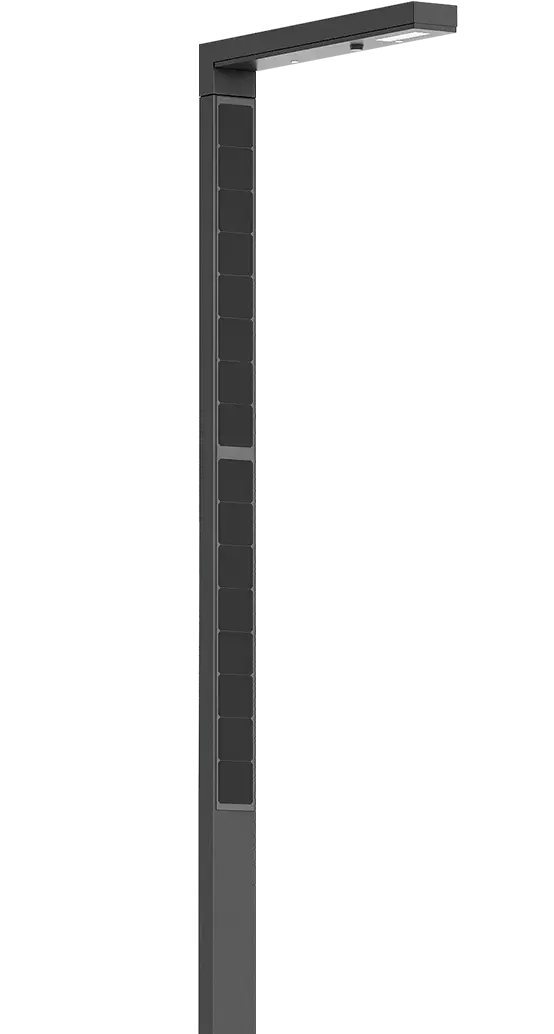
EnGo Slim
Ideal for: Industrial HQ Entrances, Administrative Boulevards, and Mixed-Use Tech Parks.
Features a sleek, zero-clutter cylindrical vertical solar pole design. High aesthetic value paired with heavy-duty structural integrity. Seamlessly integrates Smart IoT sensors and 4G connectivity.
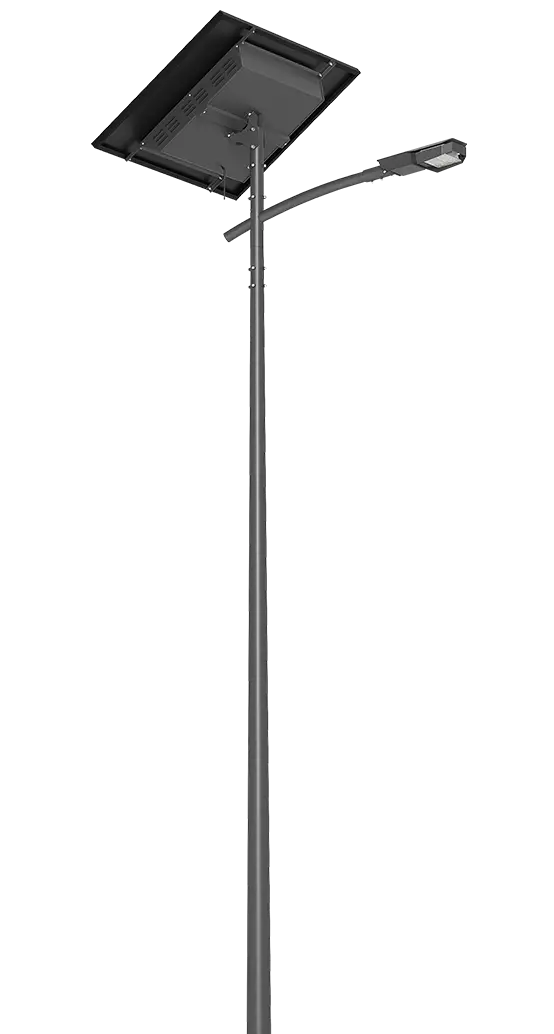
EnGo Illumo
Ideal for: Main Logistics Avenues, Heavy Freight Corridors, and Industrial Freight Yards.
Compact, ultra-robust luminaire delivering exceptional lumen density. Designed for high mounting heights (8m to 12m) to light wide multi-lane heavy vehicle thoroughfares with uniform photometric distribution.
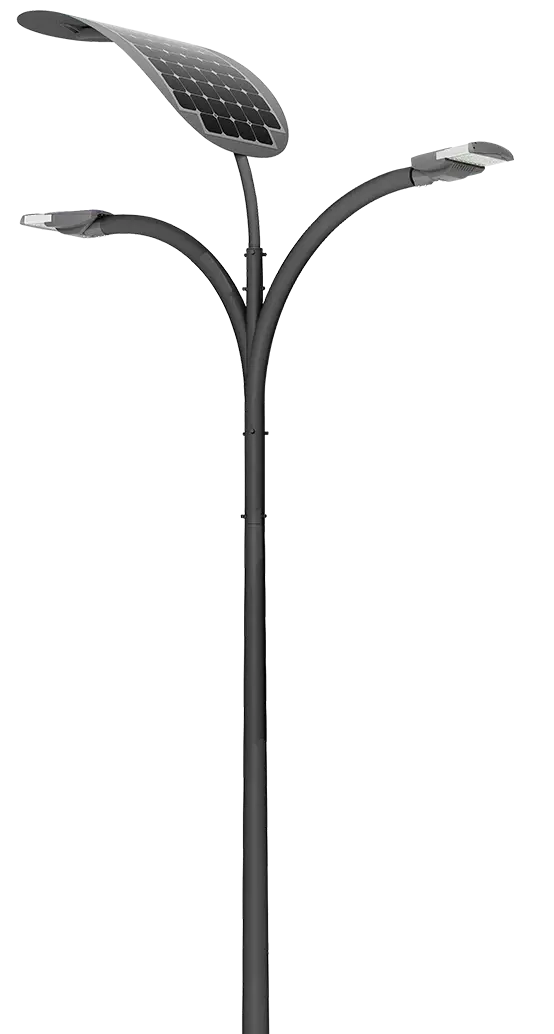
EnGo Leaf
Ideal for: Northern Hemisphere Industrial Zones, Low-Sunlight Regions, & Perimeter Security.
Engineered with adaptive energy harvesting algorithms and expanded PV surface area to maximize energy capture during extended winter months or high-cloud regions.
Transform Lighting Poles into Industrial IoT Hubs
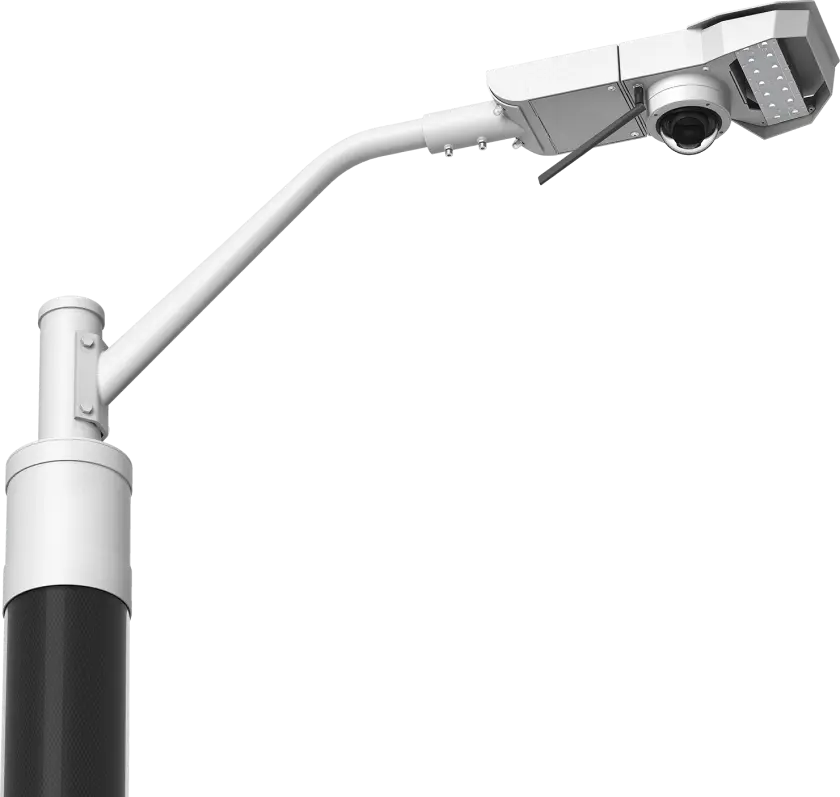
An industrial solar lighting pole should do more than emit lumens. With EnGoPlanet’s tri-module smart platform, each pole becomes a autonomous security and telemetry node across your facility.
- EnGo Light: Dynamic adaptive motion-sensing LED dimming (0-100%).
- EnGo Monitor: 4K CCTV perimeter monitoring & industrial air quality sensing.
- EnGo Connect: Private 4G/5G Wi-Fi coverage for site logisticians & AGVs.
4. Future Procurement Trends in Industrial Zone Solar Lighting
As industrial real estate shifts toward Industry 4.0 automation, smart supply chains, and net-zero energy buildings, procurement strategies for site infrastructure are undergoing rapid evolution. Key industry trends driving procurement over the next 5 to 10 years include:
4.1 Shift from CAPEX to LaaS (Lighting-as-a-Service) Models
Industrial park managers are increasingly moving away from direct equipment purchasing toward subscription-based utility models. Under EnGoPlanet’s EnGo Utility (Solar Lighting-as-a-Service) program, enterprises pay a predictable monthly operational fee with zero upfront capital expenditure. EnGoPlanet retains ownership, monitoring, and lifetime maintenance responsibility, eliminating operational risk for the facility owner.
4.2 AI-Driven Adaptive Dimming & Dynamic Load Management
Next-generation industrial solar lights no longer run at fixed 100% wattage continuously. Smart microcontrollers running localized AI logic analyze real-time traffic density, shift patterns, weather forecasts, and state-of-charge (SoC) profiles. For example, during low-activity windows (e.g., 2:00 AM to 4:00 AM), lights dim to 30% ambient output, instantly ramping up to 100% when microwave motion sensors detect approaching freight trucks or security personnel.
4.3 Convergence of Solar Lighting with AGV & Autonomous Yard Operations
Automated Guided Vehicles (AGVs) and autonomous yard trucks in modern logistics centers rely on clear optical guidance, obstacle detection, and continuous data connectivity. Solar light poles are morphing into multipurpose infrastructure columns—housing LiDAR sensors, edge-computing nodes, and wireless charging assist points, converting passive lighting poles into active supply chain assets.
4.4 Circular Economy & Modular Maintenance Architecture
Global environmental regulations now require industrial equipment to be fully recyclable and modular. EnGoPlanet designs solar street lights with quick-connect modular components. LED drivers, battery packs, microcontrollers, and PV modules can be hot-swapped in under 15 minutes by field technicians without needing specialized boom trucks or structural demolition.
5. Total Cost of Ownership (TCO) & Financial Analysis
To quantify the economic advantage of switching to Industrial Zone Solar Lighting, consider a standard comparison for a new 10-hectare industrial logistics park requiring 100 outdoor lighting poles along internal roadways and perimeter fences over a 10-year operational lifecycle:
| Cost Factor (100 Poles / 10-Year Horizon) | Traditional Grid LED Infrastructure | EnGoPlanet Off-Grid Solar System |
|---|---|---|
| Substation, Transformers & Switchgear | $45,000 | $0 (Not Required) |
| Trenching, Conduits & Underground Cabling | $120,000 ($60/ft avg.) | $0 (Zero Trenching) |
| Luminaires & Poles Purchase (CAPEX) | $65,000 | $115,000 |
| Labor & Civil Installation Costs | $55,000 | $18,000 (Fast Flange Mounting) |
| 10-Year Electricity Utility Bills (OPEX) | $98,000 ($0.16/kWh avg.) | $0 (100% Solar Powered) |
| Preventative Maintenance & Cable Repairs | $25,000 | $12,000 (Battery Check @ Year 10) |
| Total 10-Year Expenditure | $408,000 | $145,000 |
| NET 10-YEAR SAVINGS | $263,000 Total Cost Reduction (64.4% Savings) | |
By eliminating site civil works, trenching labor, transformer upgrades, and ongoing electricity bills, the higher initial luminaire investment of off-grid solar is typically fully amortized within 18 to 24 months of project commissioning.
6. Why Industry Leaders Partner with EnGoPlanet
EnGoPlanet Energy Solutions LLC (headquartered in Houston, Texas) is a world leader in smart off-grid solar infrastructure. With over 500+ successful project deployments across 40+ countries, our systems are engineered and tested to survive the most demanding industrial settings.
USA Engineering & Quality Control
Designed, assembled, and quality-tested in Houston, Texas. Built strictly to North American electrical and structural standards (UL, CE, RoHS, ISO9001 certified).
Proven Critical Facility Deployments
Trusted by high-security enterprises including SpaceX facilities (Boca Chica, TX), AT&T, Michelin industrial sites, and municipal leaders such as the City of Las Vegas and Boston.
End-to-End Turnkey Support
From DIALux optical layout simulation and solar radiance sizing calculations to custom pole engineering and lifetime remote software maintenance.
Real-World Industrial & Infrastructure Case Studies

SpaceX Facility — Boca Chica, TX
Off-grid industrial solar street lighting deployed along coastal high-wind rocket launch testing corridors.
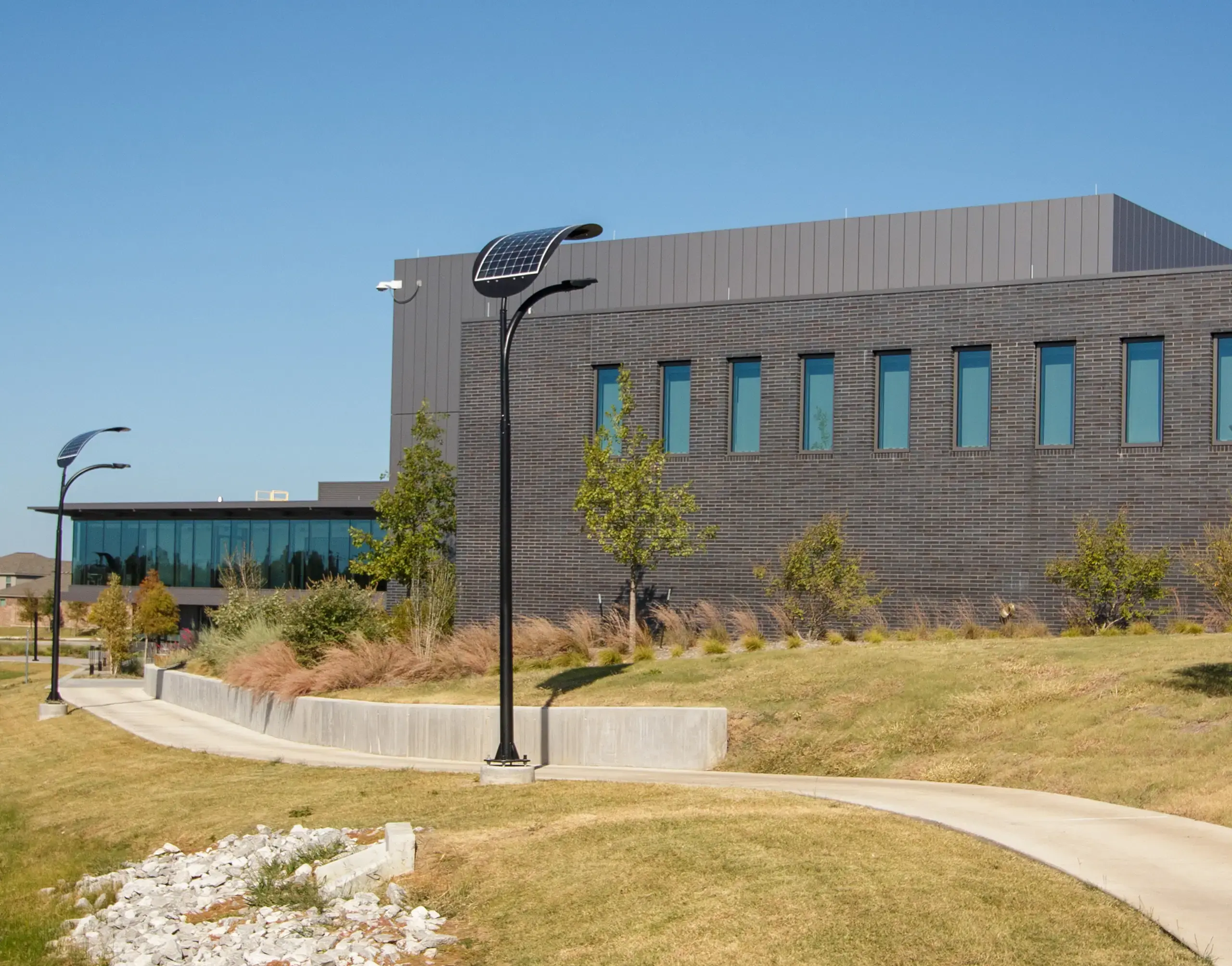
Logistics & Freight Hub Deployment
Zero-trenching heavy vehicle access roads illuminated with high-lumen EnGo Illumo poles.

Lustica Bay Infrastructure Project
EnGo Slim poles providing reliable coastal illumination, resisting salt spray corrosion and high humidity.
7. Frequently Asked Questions (FAQ) for Industrial B2B Buyers
Here are expert answers to the most common questions searched by facility managers, EPC contractors, and procurement officers when evaluating industrial solar lighting systems:
Ready to Upgrade Your Industrial Site Lighting?
Contact EnGoPlanet’s enterprise engineering team today for a customized DIALux photometric layout, detailed ROI projection, and system architectural consultation.