
Solar Lighting Blog & News
Latest news, technical guides, and expert perspectives on smart solar street lights, off-grid infrastructure, and clean energy technology.
Executive Summary & Market Intelligence
The global transition toward off-grid municipal infrastructure has transformed the commercial lighting landscape. Municipalities, EPC contractors, and industrial project developers no longer view integrated solar street lights as basic illuminating fixtures, but as high-reliability energy assets. An integrated (All-in-One) solar street light seamlessly merges a high-efficiency photovoltaic module, long-life Lithium Iron Phosphate (LiFePO4) energy storage, Maximum Power Point Tracking (MPPT) charge controller, and high-lumen LED arrays into a consolidated aerodynamic enclosure.
According to recent infrastructure audit data, transitioning from traditional grid-tied high-pressure sodium (HPS) or conventional split solar systems to smart integrated solar street poles eliminates up to 100% of subterranean trenching and cabling overheads. This report analyzes the world's leading manufacturers and exporters, establishing technical evaluation benchmarks rooted in real-world photometrics, thermal stability, and long-term Information Gain for procurement decision-makers.
Structural Integration
Eliminates external wiring points, mitigating corrosion risks, wind-resistance friction, and unauthorized tampering in municipal corridors.
MPPT Architecture
Advanced tracking algorithms yield 98.5% charging efficiency, maintaining system autonomy across 5 consecutive overcast days.
Thermal Resilience
Grade-A LiFePO4 chemistry equipped with heat-dissipating aluminum alloy frames operating reliably from -20°C to +65°C.
High-Performance Solar Street Light Catalog
Explore premier off-grid lighting solutions engineered for high lumen output, severe environmental endurance, and zero energy costs.
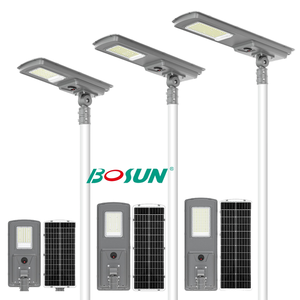
Dusk to Dawn All in One Solar Street Light Outdoor Waterproof
Rating: IP67 Waterproof / PIR Sensor
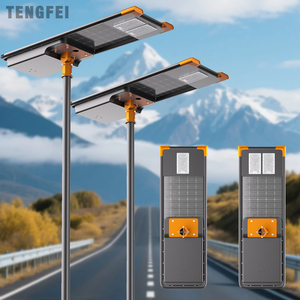
Hot Selling Low-energy Split Solar Street Light Outdoor Led Street Lighting Lamp
Application: Main Arterial Roads
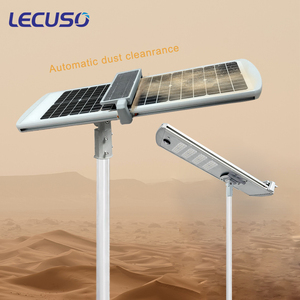
High Quality 30w-150w Automatic Auto Clean Self Cleaning Solar Street Light
Power: 30W / 60W / 100W / 150W Options
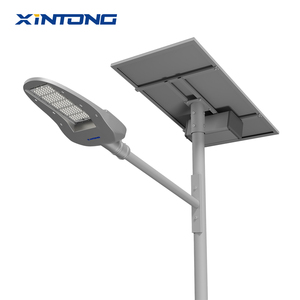
Road Light 60W 80W 100W 120W 150W Solar Street Lamp Split Solar Street Light
Body: Die-Cast Aluminum Alloy
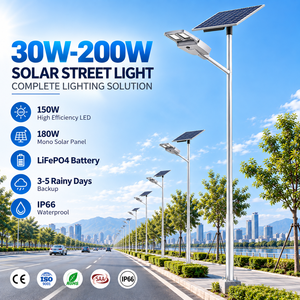
All In Two Lamp LED Solar Street Light IP66 with Battery Backup
Storage: Built-in LiFePO4 Pack
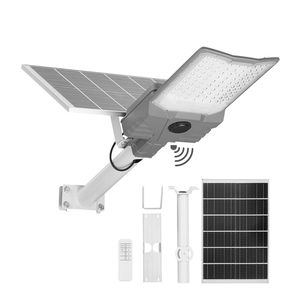
12000W High-Powered Solar Floodlight Dusk-Dawn 6500K 240° Beam
CCT / Beam: 6500K / 240° Wide Spread
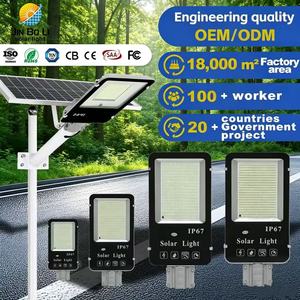
Remote Control IP67 Solar LED Light 50W-300W RoHS Certified
Certifications: CE, RoHS, IP67

Commercial Grade 60W 120W Integrated All-in-One Street Light
Target: Municipal & Commercial Highway
Technical Evaluation Matrix: Top Supplier Benchmarks
Selecting an enterprise-grade exporter requires deep auditing beyond surface-level wattage claims. True reliability rests upon component electrochemistry, conversion efficiency, thermal dissipation design, and firmware optimization. Below is an engineering comparison matrix defining tier-1 manufacturing metrics against standard market offerings:
| Evaluation Parameter | Tier-1 Exporters (EnGoPlanet & Leaders) | Generic Commodity Manufacturers | Engineering Operational Impact |
|---|---|---|---|
| Solar Cell Chemistry | N-Type TOPCon / Monocrystalline (22.5%+ Efficacy) | Polycrystalline (16%-18% Efficacy) | +30% power generation under low-irradiance overcast skies. |
| Energy Storage Tech | Grade-A LiFePO4 (BYD/CATL cells, 6,000 cycles) | Recycled Li-ion / Ternary NMC (<1,200 cycles) | Prevents thermal runaway; guarantees 10+ year battery lifespan. |
| Charge Controller | Smart MPPT with Dual-Peak Tracking (>98.5%) | Basic PWM Controllers (<75% Efficiency) | Extracts up to 30% more energy during partial shading conditions. |
| Optical Distribution | Custom Batwing Type II/III Anti-Glare Lenses | Flat Glass / Standard 120° Diffusers | Eliminates light pollution while expanding pole spacing by 35%. |
| Ingress & Impact | IP67 Enclosure with IK10 Vandal Resistance | IP65 Plastic/Thin Die-cast (IK07) | Resists hurricane-force winds, coastal salt spray, and physical impacts. |
| IoT Connectivity | 4G/5G/LoRaWAN Remote Central Management | Standalone Photocell / Simple IR Remote | Enables real-time fault alerts, remote dimming schedules, and telemetry. |
Future Industry Trends: The 2026–2030 Roadmap
The global solar lighting industry is undergoing a paradigm shift driven by artificial intelligence, advanced material science, and circular economy requirements. Sourcing managers must align procurement strategies with these core technological shifts:
1. AIoT & Dynamic Adaptive Dimming
Next-generation integrated luminaires no longer rely on rigid timer profiles. Integrated Edge-AI processors evaluate historical weather forecasts, traffic density sensors, and state-of-charge (SoC) metrics to dynamically calibrate light levels. This prolongs battery operational reserves indefinitely during extreme winter anomalies.
2. Vertical Bifacial & Self-Cleaning Solar Poles
Top exporters are transitioning from flat-tilted panels toward vertical cylindrical solar poles and automated cleaning wiper systems. Vertical wrapped bifacial modules collect ambient ground reflections while completely resisting snow accumulation and sand buildup in arid regions, reducing O&M cycles by 80%.
3. Multi-Functional Smart City Infrastructure
Solar poles are evolving into urban digital backbones. Modern systems natively incorporate 5G micro-cells, environmental monitoring sensors (PM2.5/PM10), EV charging stations, and public emergency push buttons—transforming a lighting asset into a revenue-generating smart municipal node.
Enterprise Advantage: USA Engineering & Global Capabilities
As an industry-leading manufacturer and solution architect, EnGoPlanet bridges cutting-edge US engineering precision with scalable high-volume international production. Whether deploying off-grid solar infrastructure along municipal highways, federal safety rest areas, or remote industrial zones, our turnkey capabilities guarantee zero downtime and maximum return on investment.
Solar Lighting as a Service (SLaaS)
Zero upfront capital expenditure (CapEx) models via EnGo Utility. We fund, install, operate, and maintain off-grid lighting assets under flexible municipal subscriptions.
Bespoke OEM / ODM Prototyping
Full structural photometrics, 3D CAD rapid modeling, custom CCT tuning (2700K-6500K), and tailored mounting hardware engineered to local wind speed standards (>160 mph).
Complete Lifecycle Asset Care
Comprehensive post-warranty support, preventative battery monitoring, and modular upgrade paths ensuring infrastructure remains functional for over two decades.
B2B Procurement & Engineering FAQ
What is the structural difference between All-in-One and All-in-Two/Split solar street lights?
An All-in-One (Integrated) solar street light combines the solar panel, LiFePO4 battery pack, MPPT controller, and LED module within a single compact body. This allows ultra-fast installation (less than 15 minutes per pole) and minimizes wind resistance. Split or All-in-Two systems separate the solar panel or battery box, making them ideal for high-wattage highway applications (>150W) requiring massive solar panels tilted at specialized angles in high-latitude environments.
How do LiFePO4 batteries compare to traditional Lead-Acid or Ternary Lithium (NMC) batteries in solar applications?
Lithium Iron Phosphate (LiFePO4) is the undisputed gold standard for solar street lighting. LFP offers over 4,000 to 6,000 charge/discharge cycles at 80% Depth of Discharge (DoD), compared to only 500–800 cycles for lead-acid and ~1,500 for NMC. Furthermore, LiFePO4 exhibits extreme thermal stability, eliminating thermal runaway risks up to 65°C, making it safe for harsh desert environments.
How is system autonomy calculated for overcast or rainy days?
System autonomy refers to the number of consecutive non-sunny days the light can operate purely on stored battery energy. Top-tier engineering specs require at least 3 to 5 days of autonomy. This is calculated using the formula: Autonomy (Days) = (Battery Capacity in Wh * Depth of Discharge) / Daily LED Consumption in Wh. Smart MPPT controllers continuously dim lights to 30% during inactivity (PIR/microwave sensing) to double effective autonomy.
Why is MPPT charging essential over standard PWM controllers?
Maximum Power Point Tracking (MPPT) digitally monitors the solar panel's V-I curve and adjusts the operating voltage to extract maximum available wattage regardless of temperature variations. MPPT delivers 97% to 99% conversion efficiency—yielding up to 30% more daily charge energy into the battery compared to legacy Pulse Width Modulation (PWM) circuits.
What photometric standards should be requested for highway vs residential projects?
Highway projects typically mandate IESNA Type II or Type III medium optical lenses with light distributions focused along long, narrow roadway vectors, maintaining an illumination uniformity ratio (Emax/Emin) under 3.0. Residential pathways require Type I or Type V symmetric distributions with warm-to-neutral color temperatures (3000K-4000K) to limit glare and preserve nighttime environment aesthetic quality.
How does automatic self-cleaning technology affect Total Cost of Ownership (TCO)?
Dust, airborne particulate, bird droppings, and soot can reduce solar panel output by up to 40% in dry or desert regions. Integrated robotic self-cleaning brushes cycle daily across the PV glass, restoring 99% of original solar efficiency. This eliminates manual cleaning bucket-truck dispatches, reducing operational maintenance costs by thousands of dollars per pole over a 10-year lifespan.
Accelerate Your Sustainable Infrastructure Today
Consult with our senior solar application engineers to request photometrics, DIALux lighting layouts, custom RFP quotes, or factory inspection audits.
Inquire Now