
Solar Lighting Blog & News
Latest news, technical guides, and expert perspectives on smart solar street lights, off-grid infrastructure, and clean energy technology.
Featured Industrial Solar Lighting Systems
Explore top-tier off-grid solar street and high-mast luminaires engineered for extreme weather resilience, high-lumen output, and automated continuous operation.
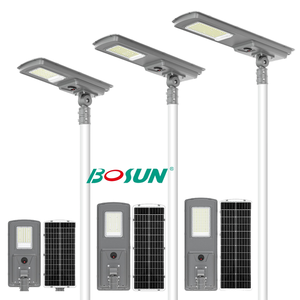
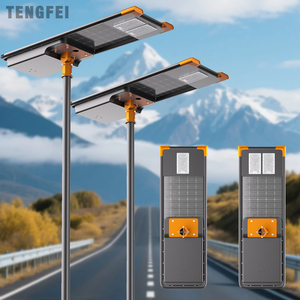
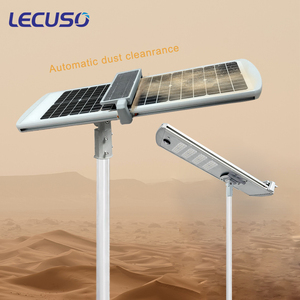
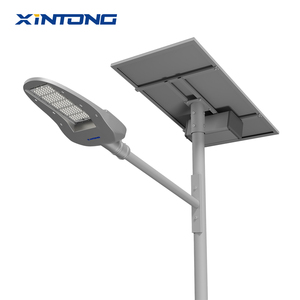
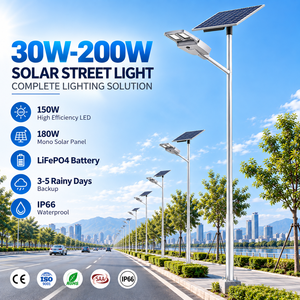
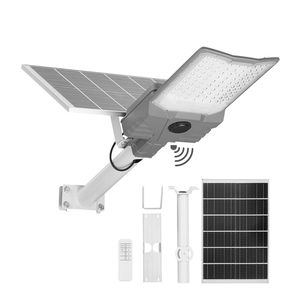
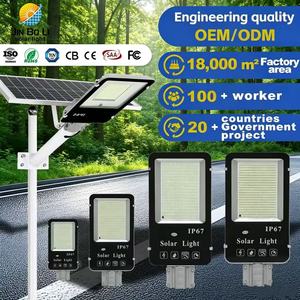

Executive Summary: The Evolution of High Mast Solar Lighting
High mast lighting systems—defined as elevated lighting structures mounting luminaire clusters at heights ranging from 15 meters to over 50 meters (50 ft to 160+ ft)—represent the pinnacle of area illumination engineering. Historically dependent on high-pressure sodium (HPS) or metal halide lamps drawing upwards of 400W to 2000W per fixture, these systems required heavy utility grid trenching, step-up transformers, and massive operational expenditures. Today, the global energy landscape is undergoing a structural transition toward decentralized, off-grid high-mast solar lighting systems.
The convergence of ultra-high-efficacy solid-state LEDs (>200 lm/W at chip level), high-efficiency N-type TOPCon monocrystalline photovoltaics (exceeding 22.5% module efficiency), and long-cycle Lithium Iron Phosphate (LiFePO4) chemistry has fundamentally changed the Levelized Cost of Light (LCOL). Modern high mast solar systems eliminate 100% of civil trenching costs—which often account for 50% to 70% of total project capital expenditure in remote highways, maritime container terminals, rail yards, and mining sites.
Top 10 High Mast Solar Lighting System Manufacturers & Suppliers
An objective technical review based on optical design flexibility, dynamic wind load engineering, battery management resilience, IoT integration capability, and total cost of ownership (TCO).
1. EnGoPlanet Energy Solutions LLC
Corporate Overview & E-E-A-T Profile: Headquartered in Houston, Texas, EnGoPlanet is a leading innovator in smart solar street poles and off-grid high mast lighting systems. Built specifically for demanding municipal, highway, and industrial applications, EnGoPlanet's engineering philosophy revolves around structural elegance, smart grid telemetry, and extreme durability under severe environmental stressors.
Key Technical Strengths: EnGoPlanet pioneers vertical solar pole integration (such as the EnGo Slim and EnGo Illumo series), which eliminates snow/dust accumulation and drastically reduces wind loading (EPA) compared to traditional top-mounted flat solar panels. Their high mast solutions feature proprietary MPPT charge controllers with 99.2% tracking efficiency, coupled with premium Grade-A LiFePO4 battery banks housed in underground climate-controlled vaults or insulated pole-base chambers.
Smart Platform Integration: Every EnGoPlanet system can be configured as a Smart City Node (integrating EnGo Light high-efficiency fixtures, EnGo Monitor environmental/traffic sensors, and EnGo Connect 4G/5G Wi-Fi micro-cells). Their installations at high-profile sites including SpaceX facilities in Texas, municipal boulevards in Las Vegas, and luxury developments at Lustica Bay establish them as the premium choice for mission-critical infrastructure.
2. Signify (Philips SunStay & High Mast Series)
Overview: As the global leader in lighting, Signify (formerly Philips Lighting) offers specialized high mast solar floodlighting systems utilizing their SunStay and Gen2 hybrid architectures. Their systems excel in optical precision and global logistics capabilities.
Technical Evaluation: Signify integrates its proprietary Interact City management software, allowing central control rooms to monitor battery state-of-health (SOH), adjust dimming profiles dynamically based on ambient weather, and predict maintenance schedules. However, their systems often carry a premium brand surcharge and rigid component customization options.
3. SEPCO (Solar Electric Power Company)
Overview: Operating for over three decades, Florida-based SEPCO specializes in heavy-duty split-type solar lighting assemblies designed for military bases, commercial ports, and industrial roadways.
Technical Evaluation: SEPCO excels in structural calculations under hurricane-force wind conditions. Their high mast structures use heavy-gauge steel poles and oversized aluminum battery enclosures. While exceptionally rugged, their traditional industrial design aesthetic may not suit modern urban smart-city architectural projects.
4. Valmont Industries (Structures & Solar Solutions)
Overview: Valmont is a global giant in structural steel poles, lattice towers, and high-mast lowering ring mechanisms. Their solar integration division combines industrial-grade poles with custom solar arrays.
Technical Evaluation: Valmont’s primary advantage is its motorized lowering winch system, allowing maintenance teams to bring luminaire rings down to ground level for service without bucket trucks. They frequently partner with third-party solar electronics providers to complete their high-mast systems.
5. Fonroche Lighting
Overview: France-based Fonroche Lighting focuses exclusively on off-grid solar lighting, operating extensive manufacturing facilities dedicated to high-performance nickel-alloy and NiMH battery energy storage system (BESS) integrations.
Technical Evaluation: Fonroche’s proprietary Power365 battery management system guarantees 365 nights of uninterrupted light per year without dimming. Their high mast solutions are widely deployed across European transport hubs and African highway bypasses.
6. Sunna Design
Overview: Sunna Design specializes in solar lighting systems designed for high ambient temperatures (+65°C) and remote off-grid environments in the Middle East and Africa.
Technical Evaluation: Sunna’s embedded electronics monitor ambient temperature dynamically, dialing back LED driver currents during extreme heat waves to protect LED junction temperatures (Tj) and extend battery lifespan beyond 10 years.
7. Leadsun
Overview: Recognized for originating early "All-in-One" solar engine patents, Leadsun provides versatile off-grid lighting structures across Asia-Pacific and North America.
Technical Evaluation: Their modular split and integrated systems feature lightweight aluminum frameless solar panels. While highly effective for 6m–12m poles, high-mast setups (>18m) require multi-engine brackets which increase effective wind area.
8. Greenshine New Energy
Overview: Based in Lake Forest, California, Greenshine provides customized solar lighting systems for commercial parking lots, pathways, and perimeter high-mast applications.
Technical Evaluation: Greenshine offers engineering calculations for solar sizing tailored to geographical sun-hour maps (NREL data). Their modular components allow clients to select between underground battery boxes and pole-mounted enclosures.
9. Sol Inc. (Sub-brand of Acuity Brands)
Overview: Sol Inc. is one of the earliest pioneers of commercial solar street lighting in North America, now operating under the umbrella of Acuity Brands.
Technical Evaluation: Sol Inc. focuses on Dark-Sky compliant optical assemblies (zero upward light pollution) and fully integrated utility-grade solar engines designed to meet strict DOT (Department of Transportation) standards.
10. Global High-Mast OEM Alliance (SLOER / Keroa Industrial)
Overview: Representing specialized industrial OEM manufacturers capable of producing high-lumen (up to 900,000 LM theoretical floodlight arrays) split-type solar high masts at scale for international contractor bids.
Technical Evaluation: Excellent for cost-sensitive, large-scale infrastructure projects requiring raw lumen output and customizable steel fabrication. Engineering documentation and long-term warranty support depend on local distribution partners.
Comprehensive Technical Matrix
Direct engineering comparison of leading high mast solar system architects.
| Manufacturer | Primary Solar Technology | Battery Chemistry | Max System Lumens | IoT Telemetry | Warranty (System/PV) |
|---|---|---|---|---|---|
| EnGoPlanet | Vertical Wraparound / Top N-Type TOPCon | Grade-A LiFePO4 (6000+ Cycles) | 120,000+ LM (Custom High Mast) | EnGo Monitor (4G/5G/Zigbee) | 5 Years Full / 25 Years PV |
| Signify (Philips) | Top-Mount Monocrystalline | LiFePO4 / LFP Integrated | 40,000 LM | Interact City Cloud | 5 Years Limited |
| SEPCO | Rigid Flat-Panel Array | Gelled Electrolyte / LiFePO4 | 60,000 LM | Wireless Diagnostic Node | 5 Years / 25 Years PV |
| Valmont | Structural Array Mount | External Vault LiFePO4 | 100,000+ LM | Optional Third-Party IoT | 5 Years Structural/Elec |
| Fonroche | High-Efficiency Mono PV | Power365 NiMH/Special Alloy | 50,000 LM | Remote GSM Modem | 10 Years Full System |
Engineering Principles for High Mast Solar Sizing
Designing a reliable 20m to 35m off-grid solar high mast system requires rigorous physics and mathematical modeling. Unlike standard 6m garden or street light poles, high mast systems operate under severe dynamic loads and must illuminate vast spatial surfaces (such as a 10-lane highway interchange or a 50,000 m² container terminal).
1. Photometric Lux & Inverse Square Law Sizing
Illuminance ($E$) in lux at a given ground point is governed by the Inverse Square Law combined with the cosine of the light incidence angle ($\theta$):
Where $I_\theta$ is the luminous intensity in candelas at angle $\theta$, and $h$ is the mounting height. Elevating a fixture from 10 meters to 20 meters reduces illuminance by a factor of 4 for the same lumen output. Therefore, high mast solar luminaires must utilize specialized narrow or asymmetric optics (e.g., 30°×90° or IESNA Type V Forward Throw) paired with ultra-high lumen LED engines operating at >160 lm/W to maintain required ground lux levels (typically 20 to 50 Lux for industrial ports and highways).
2. Structural Wind Dynamics (EPA & AASHTO Standards)
The structural stability of high mast poles depends on calculating the Effective Projected Area (EPA) of the solar array, battery enclosures, and fixture assembly. Total wind drag force ($F_w$) is derived via:
Where $\rho$ is air density ($1.225 \text{ kg/m}^3$), $v$ is maximum wind velocity (e.g., $67 \text{ m/s}$ or $150 \text{ mph}$), $C_d$ is the aerodynamic drag coefficient, and $A$ is the projected surface area. High mast top-mounted flat solar arrays act as massive wind sails, generating high bending moments at the pole base. EnGoPlanet’s vertical solar pole wrapping technology reduces $C_d$ significantly, allowing slimmer steel pole wall thicknesses and smaller anchor bolt foundation footprints.
3. Battery Sizing & Autonomy Reserve Factor
System autonomy ($D_{aut}$) defines how many consecutive overcast or rainy days the system operates without solar harvest. Required battery bank capacity ($C_{wh}$) is computed as:
Where $P_{load}$ is fixture power in Watts, $T_{night}$ is operational night hours (e.g., 12 hours), $DoD$ is Maximum Depth of Discharge (0.80 for LiFePO4 to guarantee 6,000 cycles), and $\eta$ is driver system efficiency (typically 0.92 to 0.95). For a 200W high mast luminaire operating 12 hours nightly with 4 days of autonomy, the required usable energy storage exceeds 12,500 Watt-hours (12.5 kWh).
Why Global Infrastructure Projects Partner with EnGoPlanet
Combining US engineering precision, smart city connectivity, and zero-capex utility financing models.
USA Engineering Standards
Designed and rigorously tested in Houston, Texas under strict ISO 9001 quality management, meeting DOT and AASHTO highway specifications.
EnGo Utility Model (PPA/SaaS)
Zero upfront capital expenditure option. Municipalities and port authorities pay a predictable monthly utility fee while EnGoPlanet owns, monitors, and maintains the asset.
Integrated Smart Node Platform
Transforms traditional lighting poles into revenue-generating smart city assets equipped with 4G/5G Wi-Fi hot-spots, security monitoring cameras, and environmental sensors.
Future Procurement & Technology Trends (2025–2030)
Key macro-technological shifts shaping high-mast solar lighting specifications over the next decade.
Bifacial TOPCon & Perovskite Integration
N-Type TOPCon bifacial solar cells are replacing conventional PERC panels. By harvesting ground albedo reflections, bifacial high-mast panels yield up to 28% more total daily energy, vital during winter months with low solar elevation angles.
AI Dynamic Dimming & Anomaly Detection
Machine learning algorithms embedded directly into MPPT charge controllers now analyze live weather radar patterns and historical traffic volume. Dimming curves adjust dynamically to preserve battery health without compromising highway safety standards.
Solid-State & Sodium-Ion Battery Transition
While LiFePO4 remains the present gold standard, Sodium-Ion (Na-Ion) batteries are emerging for sub-zero industrial environments (-40°C to +60°C operating window without thermal heating jackets), reducing reliance on critical lithium raw materials.
High Mast Solar Lighting Procurement FAQ
Essential engineering and commercial answers for project engineers, procurement managers, and municipal planners.
Q: What are the main advantages of split-type high mast solar lights vs. all-in-one designs for poles over 15 meters?
For mounting heights exceeding 15 meters (50 feet), split-type or vertically integrated solar engine poles are vastly superior to single all-in-one fixtures. All-in-one units combine solar panels, battery, and LED arrays into a single housing, which creates extreme wind load resistance (EPA) at elevated pole tops and limits total solar wattage to roughly 100W–150W. Split-type high mast systems allow engineers to install 400W to 1200W+ solar arrays oriented at optimal tilt angles, with heavy battery banks secured safely at the pole base or underground for easier maintenance access.
Q: How do high mast solar lights withstand hurricane-force winds?
High mast systems are structurally engineered according to AASHTO LTS-6 (Specifications for Structural Supports for Highway Signs, Luminaires, and Traffic Signals) or Eurocode 1. Pole structures use high-strength Q345B/Q460 or structural steel with polygonal tapered cross-sections (12 to 20-sided) to dissipate aerodynamic vortex shedding. Solar bracket frames are hot-dip galvanized and FEA (Finite Element Analysis) tested to withstand continuous wind velocities up to 160 mph (71 m/s).
Q: What is the expected lifespan and maintenance schedule for a commercial high mast solar system?
A high-quality industrial solar high mast light has a structural design life of 25+ years. Photovoltaic modules carry a 25-year linear performance warranty (80% output output retention). Grade-A LiFePO4 batteries deliver 4,000 to 6,000 complete charge/discharge cycles, translating to 10–12 years of operational life before routine battery cell replacement is required. Premium LED engines (Nichia or Lumileds chips) carry L70 ratings exceeding 100,000 hours (approx. 22 years of nightly use).
Q: How does vertical solar pole technology compare to traditional angled top-mounted panels?
Vertical solar pole integration—pioneered by top manufacturers like EnGoPlanet—wraps flexible or curved solar modules vertically around the circumference of the pole shaft. This offers three major engineering benefits: (1) Reduces wind drag (EPA) by up to 60%, allowing taller poles without oversized foundations; (2) Prevents dust, sand, bird droppings, and snow from adhering to the glass surface, maintaining high energy yields without frequent washing; (3) Delivers a sleek, modern architectural aesthetic suitable for upscale urban environments.
Q: Can solar high mast systems integrate smart city IoT sensors and surveillance cameras?
Yes. High-grade systems like EnGoPlanet’s Smart Pole series incorporate dedicated DC auxiliary power buses (12V/24V/48V DC) and industrial PoE (Power over Ethernet) switches. This allows high mast poles to host HD PTZ security cameras, air quality index (AQI) monitors, traffic density radar sensors, and 4G/5G public Wi-Fi hotspots directly from the off-grid battery reserve.
Ready to Engineer Your Off-Grid High Mast Lighting Project?
Get direct access to certified solar lighting engineers. We provide free DIALux photometric renderings, wind load calculation reports, and customized project ROI analyses.