
Solar Lighting Blog & News
Latest news, technical guides, and expert perspectives on smart solar street lights, off-grid infrastructure, and clean energy technology.
High-Performance Off-Grid Solar Luminaires
Engineered for extreme reliability, zero grid dependency, and rigorous international standards. Explore our OEM customizable off-grid solar street light architectures.
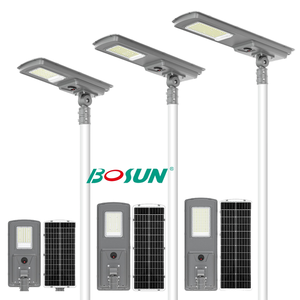
Dusk to Dawn All in One Solar Street Light Outdoor Waterproof
Ultra-compact mono-Si PV housing featuring intelligent dusk-to-dawn dimming profiles and high lumen output for municipal roadways.
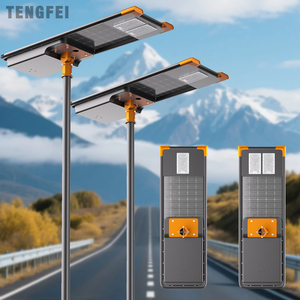
Hot Selling Low-energy Split Solar Street Light Outdoor Led Lamp
Engineered for high-latitude locations requiring flexible photovoltaic orientation and extended battery autonomy during cloudy spells.
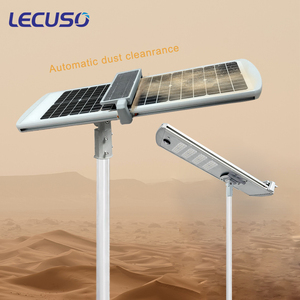
Automatic Self Cleaning Solar Street Light 30W - 150W
Patented autonomous self-cleaning brush system preventing dust accumulation and maintaining peak PV conversion in arid climates.
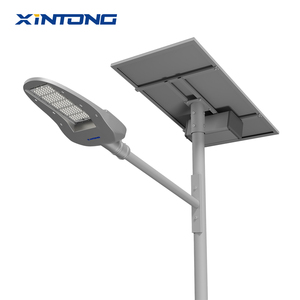
Commercial Road Light 60W-150W Split Solar Street Lamp
Industrial-grade highway lighting system featuring batwing light distribution lenses to optimize pole spacing and reduce project CAPEX.
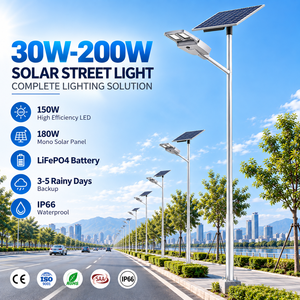
All In Two LED Solar Street Light IP66 80W-150W Battery Backup
Harmonizes sleek aesthetic integration with modular battery replacement, facilitating seamless maintenance over a 10-year lifespan.
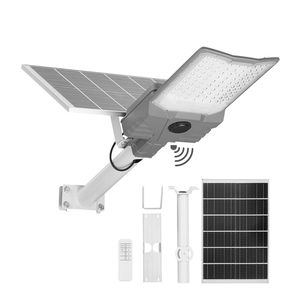
High-Lumen Industrial Solar Floodlight & Street Light 6500K
High-powered flood lighting array tailored for logistics hubs, mining sites, harbors, and large area perimeter security illumination.
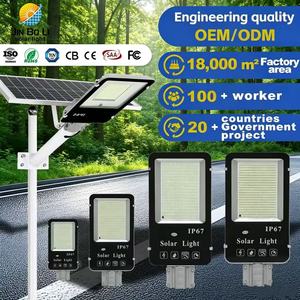
Remote Control IP67 Solar LED Light 50W-300W RoHS Certified
Versatile split lighting solution allowing customized brightness scheduling, operational mode selection, and hassle-free commissioning.

Commercial OEM All in One & Split Solar Street Light System
Fully customizable enterprise platform built specifically for government tenders, EPC contractors, and international solar lighting distributors.
Engineering Architecture of Modern Off-Grid Solar Lighting
A comprehensive technical guide for electrical engineers, procurement managers, and municipal planners evaluating utility-grade solar infrastructure.
1. System Architecture Taxonomy: All-in-One vs. All-in-Two vs. Split Systems
When specifying off-grid solar street lighting for public infrastructure, engineering teams must evaluate three structural paradigms based on solar irradiance profiles, wind load dynamics, and maintenance accessibility. As a primary OEM manufacturer, we engineer systems across all three categories:
- All-in-One (Integrated) Systems: Consolidate the monocrystalline PV panel, Lithium Iron Phosphate (LiFePO4) battery pack, MPPT charge controller, and LED array into a single aluminum alloy enclosure. Ideal for rapid deployment on urban pathways and parking lots. While offering lower wind resistance and simplified installation, max solar wattage is physically constrained by the luminaire length.
- All-in-Two Systems: Integrate the LED luminaire, battery, and controller into one housing while detaching the photovoltaic module onto an adjustable top bracket. This allows independent orientation of the PV panel toward optimal solar azimuth while pointing the optic fixture directly onto the road surface.
- Split-Type Systems: Feature separated solar panels, LED luminaires, and subterranean or pole-mounted battery enclosures. Essential for high-wattage highway applications (>100W LED), high-latitude locations requiring large surface area PV arrays (up to 350W+), and extreme thermal environments.
| Engineering Metric | All-in-One (Integrated) | All-in-Two Systems | Split-Type Systems |
|---|---|---|---|
| Max PV Panel Capacity | 60W – 140W Peak | 100W – 220W Peak | 150W – 400W+ Peak |
| Luminous Efficacy | Up to 180 lm/W | Up to 200 lm/W | Up to 220 lm/W |
| Thermal Dissipation | Moderate (Shared Housing) | Good (Isolated PV) | Superior (Fully Separated) |
| Tilt Optimization | Fixed (Determined by Arm Angle) | 360° Azimuth / 0-60° Tilt | 360° Azimuth / 0-60° Tilt |
| Wind Resistance Rating | Category 5 Hurricane (160mph) | 140 mph (Adjustable Bracket) | 130 - 150 mph (Varies by Pole) |
| Autonomy Potential | 3 to 5 Rainy Days | 5 to 7 Rainy Days | 7 to 10+ Rainy Days |
2. Advanced Photovoltaic Energy Storage & Thermal Dynamics
The operational reliability of off-grid solar infrastructure depends entirely on chemical chemistry selection and smart power management. Legacy systems utilized gel lead-acid or NCM batteries, which suffered from high thermal sensitivity, limited depth-of-discharge (DOD), and short operational cycle lives (<1000 cycles).
Our commercial OEM solutions utilize grade-A Lithium Iron Phosphate (LiFePO4) cell chemistry combined with active dual-layer Battery Management Systems (BMS). LiFePO4 chemistry delivers:
4,000+ Deep Charge Cycles
Maintains >80% capacity after 10+ years of continuous daily 80% DOD cycling, drastically reducing operational expenditure.
High Thermal Stability
Operates safely without risk of thermal runaway across ambient extremes from -20°C to +65°C, protected by aluminum heat dissipation fins.
Intelligent MPPT Algorithms
Tracks maximum power point with >99.5% efficiency, capturing up to 30% more energy during diffuse light and rainy days compared to PWM controllers.
Dust, particulate matter, and sand accumulation can drop photovoltaic conversion efficiency by up to 40% over 6 months in desert or industrial environments. Our Automatic Self-Cleaning Series incorporates an integrated brush module powered by an auxiliary motor that completes a dual-pass cleaning cycle twice daily, maintaining full rated solar charging efficiency without manual intervention.
Custom OEM/ODM Manufacturing Vectors
We partner with EPC contractors, municipal governments, and brand owners to engineer customized off-grid solar lighting systems tailored to regional specifications.
Photometric Distribution Optics
Custom optic mold engineering providing Type I, Type II-M, Type III-M, and Type IV batwing lens profiles. Designed to meet strict roadway uniformity ratio requirements (>0.4) while eliminating glare and upward spill (Dark Sky compliant).
IoT Smart City Integration
Integrated NEMA or Zhaga 7-pin sockets supporting 4G LTE Cat-M1, NB-IoT, and LoRaWAN smart control nodes. Allows remote dimming schedule adjustment, real-time energy reporting, tilt/vibration fault alerts, and automated maintenance ticketing.
Extreme Climate Hardening
Custom housing treatments including C5-M marine-grade anti-corrosion powder coatings for coastal environments, heating jackets for sub-zero lithium charging (-40°C), and structural reinforcement rated up to 160 mph wind gusts.
Hybrid Grid-Fallback Logic
For locations with unstable power grids, we offer hybrid controllers that operate 100% off-grid on solar power under normal conditions, but seamlessly switch to AC grid backup if battery capacity drops below 10% after prolonged overcast periods.
Form Factor & Aesthetic Customization
From cylindrical vertical pole-wrapped solar modules to architectural slimline profiles, we customize housing colors (RAL palette), branding logos, laser-etched nameplates, and custom mounting arm geometries.
CCT & Dynamic Spectrum Control
Tailored Correlated Color Temperature (2700K to 6500K) options, including amber wildlife-friendly lighting (590nm wavelength) for coastal turtle nesting areas and ecological reserves requiring low atmospheric scattering.
Future Procurement & Technology Trends
Key technological shifts driving international government tenders, EPC procurement strategies, and sustainable infrastructure investment over the next decade.
1. Vertical Solar Pole Architecture replacing Flat Panels
A major procurement trend in high-end municipal urban design is the shift toward vertical cylindrical solar poles. By wrapping flexible monocrystalline cells 360° around the vertical pole shaft, municipal authorities eliminate snow accumulation, dramatically reduce wind load drag coefficients, and prevent bird dropping contamination while maintaining clean architectural lines.
2. Transition from Standalone Fixtures to Smart Utility Nodes (LaaS)
Off-grid solar street lights are expanding from simple illumination fixtures into self-powered smart city hardware platforms. Modern procurement tenders frequently mandate auxiliary DC power ports (12V/24V) to supply secondary payloads, including environmental air quality sensors, traffic monitoring cameras, public Wi-Fi hotspots, and emergency push-to-talk call boxes—all operating entirely off-grid.
3. Circular Economy & Modular Right-to-Repair Compliance
Global buyers are rejecting throwaway solar lights with glued components. Procurement frameworks now prioritize modular construction with quick-disconnect IP68 cabling, toolless battery compartment access, and standardized LED module drivers, ensuring that individual sub-assemblies can be serviced or upgraded over a 20-year pole lifespan.
4. AI-Driven Adaptive Dimming & Dynamic Predictive Autonomy
Next-generation MPPT controllers integrate machine-learning algorithms that analyze localized historic solar yield and 7-day weather forecast telemetry. If prolonged cloudy weather is predicted, the system autonomously adjusts dimming profiles and radar sensor delay intervals to guarantee non-stop illumination without ever depleting battery reserves below critical levels.
Frequently Asked Technical Questions
Detailed answers addressing critical engineering, sizing, thermal management, and procurement inquiries for enterprise solar lighting projects.
Why Choose Us as Your OEM/ODM Partner
Combining USA engineering leadership, robust supply chain integration, and rigorous quality control for turnkey off-grid solar deployments worldwide.
Precision Manufacturing & QC
Every luminaire undergoes 100% automated aging tests, IP67 submersion chamber verification, salt spray anti-corrosion testing, and integrating sphere photometric validation prior to global shipment.
Turnkey Engineering Support
Our in-house optical and electrical engineers assist OEM partners with DIALux photometric simulations, wind load calculations, custom bracket CAD drafting, and tender specification writing.
Global Supply Chain Agility
Strategic raw material reserves, Tier-1 monocrystalline cell sourcing, and flexible assembly lines allow us to fulfill large municipal orders with rapid lead times and full traceability.
Request a Custom OEM Project Quote & Complete Catalog
Partner with a trusted global manufacturer. Connect with our senior engineering team to discuss custom optical design, battery sizing, or municipal tender specifications.