Solar Lighting Blog & News
Latest news, technical guides, and expert perspectives on smart solar street lights, off-grid infrastructure, and clean energy technology.
How to Choose the Best Smart Solar Bus Shelter?
Table of Contents
- Define Passenger Needs, Site Capacity, and Daily Energy Demand
- Estimate Solar Yield at 1,000–1,500 kWh per Installed kW Annually
- Size Batteries for 1–3 Days of Autonomy and Safe Depth of Discharge
- Compare LED Efficiency of 100–150 lm/W, Displays, Sensors, and Charging Loads
- Verify IP65 Protection, 10–15-Year PV Life, Accessibility, and Safety Standards
- FAQS
- Conclusion
- Related Posts
Choosing the best Smart Solar Bus Shelter requires more than comparing prices and attractive product images. It means examining how the shelter performs in real public spaces, under changing weather, passenger demand, and maintenance conditions. A reliable model should provide shade, lighting, seating, route information, and safe nighttime visibility. Its solar panels must match local sunlight levels, not just marketing claims.
Begin with the site. Measure daily sunlight, nearby buildings, passenger flow, drainage, and available installation space. A shelter beside tall apartments may produce less energy than expected. Check the battery capacity, charging time, and performance during cloudy periods. Ask suppliers for test data, warranty terms, maintenance schedules, and examples from similar climates. Professional installation also matters. Poor panel angles, weak foundations, or exposed wiring can reduce performance and create avoidable risks.
Passenger comfort should guide every decision. Look for non-slip flooring, durable seating, clear signage, and accessible entry points. Lighting should be bright enough for visibility without creating glare. Smart features, such as USB charging, digital displays, sensors, and emergency communication systems, should serve practical needs. More technology is not always better.
Consider the long term. Can local technicians replace batteries and clean panels easily? Are spare parts available? Does the supplier provide responsive support? A lower purchase price may hide higher operating costs. I have seen specifications appear convincing until weather exposure revealed weak materials and unreliable controls. That is why every recommendation should remain open to review. The best Smart Solar Bus Shelter balances energy efficiency, safety, accessibility, durability, and honest lifecycle value.
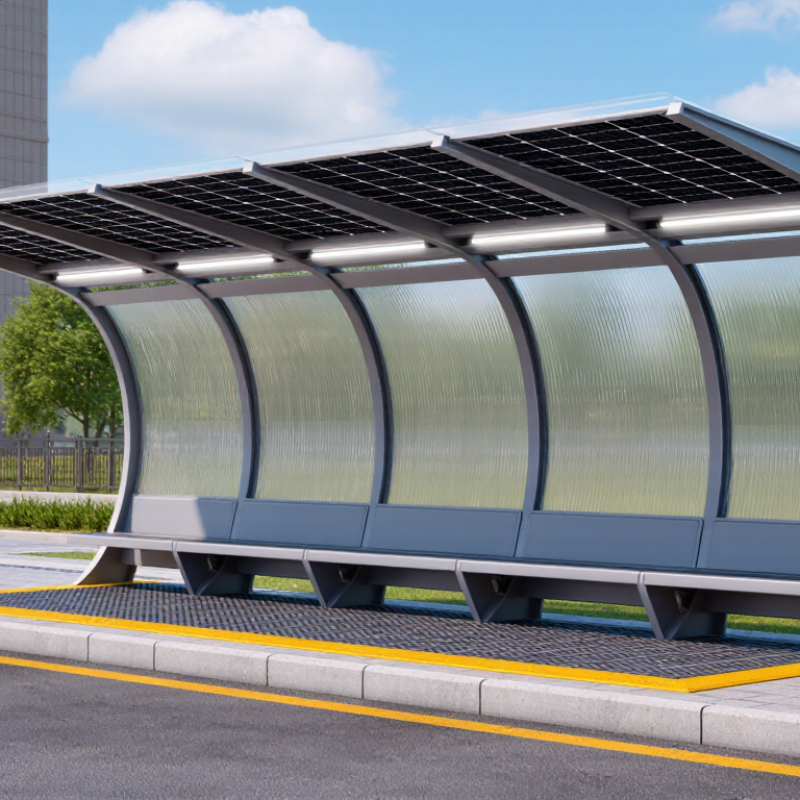
Define Passenger Needs, Site Capacity, and Daily Energy Demand
Choosing the best smart solar bus shelter starts with passengers, not panels. Observe the site during morning and evening peaks. Count waiting passengers, wheelchair users, cyclists, and people carrying luggage. The National Household Travel Survey shows that many transit trips include walking before and after the ride. Therefore, provide clear circulation, visible route information, shade, seating, and safe lighting. A shelter that powers displays but blocks a wheelchair path has failed its basic purpose.
Measure site capacity carefully. Record roof dimensions, shadow patterns, drainage, wind exposure, and available battery space. NREL’s PVWatts guidance warns that system losses reduce theoretical solar output, often by about 14% under default assumptions. Use local solar data, not optimistic brochure figures. Estimate daily demand from lighting, passenger counters, communication equipment, USB charging, and winter heating. The International Energy Agency reports that solar output varies strongly by season and weather. A small battery may support one clear day, but not several cloudy nights.
Tips: Begin with a seven-day observation log. Add a 25% energy reserve. Use efficient LED lighting; the U.S. Department of Energy reports that LEDs use at least 75% less energy than incandescent lighting. Test the shelter after installation. Real passenger behavior may differ from the design model. That difference deserves attention.
Estimate Solar Yield at 1,000–1,500 kWh per Installed kW Annually
How to Choose the Best Smart Solar Bus Shelter?
A smart solar bus shelter should match its location, passenger demand, and daily energy needs. As a practical planning range, estimate 1,000–1,500 kWh per installed kW annually. A 3 kW system may therefore produce about 3,000–4,500 kWh each year. This estimate is useful, but it is not a promise. Roof direction, nearby buildings, dust, snow, and seasonal shadows can reduce output. Measure the site carefully before approving the design.
Look for durable panels, safe wiring, weather-resistant lighting, and a battery sized for night operations. Real shelters often power LED lights, arrival displays, cameras, USB charging, or communication equipment. These loads vary sharply during winter evenings and busy travel periods. Installers should provide a shading study, local solar data, expected losses, and a clear maintenance plan. Ask how performance will be monitored. A simple dashboard can reveal low output before passengers notice dark lighting. I have found that early projections sometimes look too confident. Actual data should challenge the original estimate.
Tips: Check solar yield by month, not only by year. Leave space for cleaning access. Test lighting after sunset. Confirm the battery can support several cloudy days. Review drainage, ventilation, and vandal-resistant construction. Keep the design practical. More technology is not always better. A shelter that produces energy but fails during heavy rain is poorly chosen. Evaluate comfort, accessibility, visibility, and service records alongside annual kilowatt-hour estimates.
Size Batteries for 1–3 Days of Autonomy and Safe Depth of Discharge
A smart solar bus shelter needs a battery sized for real weather, not average weather. Begin by listing every load: LED lighting, passenger displays, cameras, sensors, and emergency communication equipment. Record each device’s watts and operating hours. Daily energy use equals the combined watt-hours consumed in 24 hours.
Select one to three days of autonomy based on winter sunlight and site importance. A two-day design is often a practical starting point.
For example, a shelter using 1,800 watt-hours daily needs about 5.3 kWh of nominal battery capacity with 85% system efficiency and an 80% depth of discharge. The calculation is simple: daily energy multiplied by autonomy days, divided by efficiency and usable depth of discharge.
Add reserve capacity for aging, cold temperatures, and unexpected demand.
Small margins matter.
Never treat the full battery rating as usable energy.
A safe depth of discharge protects cycle life and reduces sudden shutdowns. Lithium batteries may support deeper discharge, but the battery supplier’s tested limits should control the design. Other chemistries may require a much larger reserve.
Include a battery management system, temperature monitoring, overcurrent protection, and weather-rated housing.
During commissioning, measure overnight consumption instead of trusting the spreadsheet alone. Spreadsheets can be wrong. I have seen display brightness and winter heating increase demand sharply. Recheck the system after several weeks, then adjust lighting schedules or solar capacity when field data reveals a weakness.
Compare LED Efficiency of 100–150 lm/W, Displays, Sensors, and Charging Loads
Choosing a smart solar bus shelter starts with measured lighting, not attractive specifications. For sheltered platforms, LED systems rated at 100–150 lumens per watt offer a practical efficiency range. The U.S. Department of Energy’s 2023 Solid-State Lighting R&D Opportunities report identifies higher efficacy as a key development target. This makes 100–150 lm/W useful, but not automatically superior. Optical losses, dirt, heat, and dimming can reduce real output.
Start with the load. A bright display may consume more energy than several sensors combined. Passenger information screens need visibility in sunlight, while air-quality, occupancy, and motion sensors usually require modest power. The International Energy Agency’s Global EV Outlook 2024 reports continued growth in public charging demand, reinforcing the need to separate shelter lighting from charging circuits. Night changes everything. A phone-charging outlet can create an unpredictable evening peak, especially during bad weather.
A useful design test records watt-hours, not only rated watts. Measure LED output at midnight, screen brightness, sensor activity, and charging use for several weeks. PV production should be checked with local solar data, while battery capacity should cover cloudy periods without deep discharge. The National Renewable Energy Laboratory’s PVWatts guidance supports site-specific solar estimates rather than generic averages. I would still question any design promising complete autonomy without seasonal testing. It sounds efficient, but field performance is rarely so tidy.
| Configuration | LED Efficiency | LED Lighting Load | Approx. Illuminated Output | Display System | Sensor Package | Passenger Charging Load | Estimated Daily Energy | Suggested PV Size | Best Use Case |
|---|---|---|---|---|---|---|---|---|---|
| Essential Shelter | 100 lm/W | 60 W | 6,000 lm | No passenger information display | Photocell, ambient temperature, battery voltage | 2 × USB-C ports, up to 30 W each | 0.66 kWh/day | Approx. 250 W | Low-load lighting |
| Balanced Smart Shelter | 120 lm/W | 50 W | 6,000 lm | 32-inch LCD, approximately 90 W while active | Photocell, temperature, humidity, air quality, occupancy | 2 × USB-C ports, up to 45 W each | 1.74 kWh/day | Approx. 600 W | Best overall balance |
| Connected Transit Shelter | 135 lm/W | 45 W | Approx. 6,075 lm | 43-inch sunlight-readable LCD, approximately 150 W while active | Photocell, temperature, humidity, air quality, occupancy, noise level | USB-C and wireless charging, up to 300 W combined | 2.95 kWh/day | Approx. 1.1 kW | High-information routes |
| Maximum-Service Shelter | 150 lm/W | 40 W | 6,000 lm | 55-inch high-brightness LCD, approximately 180 W while active | Full environmental, occupancy, air-quality, noise and emergency-status monitoring | Multiple USB-C ports, up to 450 W combined | 3.62 kWh/day | Approx. 1.3 kW | High-traffic smart hubs |
Verify IP65 Protection, 10–15-Year PV Life, Accessibility, and Safety Standards
How to Choose the Best Smart Solar Bus Shelter?
A reliable smart solar bus shelter begins with protection, not flashy screens. Verify an IP65 rating through independent test reports. IP65 protects equipment from dust and water jets, but not flooding or immersion. Inspect cable glands, roof joints, and control boxes closely. Small gaps can become expensive failures after heavy rain. Ask for maintenance records from similar installations, if available.
The photovoltaic system should support dependable service for 10–15 years. Check the panel warranty, expected annual degradation, battery replacement plan, and performance under cloudy conditions. A shelter may produce less power during winter than sales estimates suggest. That detail deserves honest discussion. Accessibility also needs practical review. Provide a clear wheelchair route, suitable seating, high-contrast signs, tactile guidance, and an unobstructed boarding area. Lighting should help older passengers read information without creating glare.
Tips: Request structural calculations for local wind and snow loads. Confirm electrical protection, grounding, emergency shutoff access, and relevant safety certifications. Test the shelter at night and during rain, not only on installation day. Listen to passengers and drivers; their observations often reveal problems that drawings miss. A technically compliant shelter can still feel uncomfortable. Leave enough space for movement.
How to Choose the Best Smart Solar Bus Shelter?
Verify IP65 protection, a 10–15-year PV service period, accessibility, and applicable electrical, structural, and safety standards before purchase.
This chart models remaining PV output using a typical crystalline-silicon degradation assumption of 0.5% per year. At year 10, approximately 95.1% of initial output remains; at year 15, approximately 92.8% remains. Confirm the supplier’s warranty and service-life documentation. IP65 means dust-tight protection and resistance to water jets. For an accessible U.S. route, verify at least 36 inches of clear width and a 60-inch turning space where required by the applicable accessibility standard.
FAQS
Observe morning and evening peaks for seven days. Count passengers, wheelchair users, cyclists, and people carrying luggage. Measure roof size, shadows, drainage, wind exposure, and battery space. Clear movement matters more than extra screens.
Keep the boarding area and wheelchair route completely unobstructed. Add suitable seating, high-contrast signs, tactile guidance, and readable lighting. Check the shelter with real passengers. Drawings may miss practical problems.
List lighting, displays, counters, sensors, communication equipment, charging ports, and heating. Record each device’s power and operating hours. Add their daily watt-hours together. Display brightness can change the result.
Design for one to three days without strong sunlight. Two days is a reasonable starting point for many sites. Important winter locations may need more capacity. Cloudy nights matter.
Multiply daily energy use by autonomy days. Divide by system efficiency and usable depth of discharge. For 1,800 watt-hours daily, two days needs about 5.3 kilowatt-hours nominal capacity under stated assumptions. Add reserve capacity for aging, cold, and unexpected demand.
A battery’s full rating is not fully usable. Safe depth of discharge protects cycle life and reduces sudden shutdowns. Include temperature monitoring, overcurrent protection, and a battery management system. Recheck the limits.
IP65 protects equipment from dust and water jets. It does not protect against flooding or immersion. Inspect cable glands, roof joints, and control boxes. Small gaps can cause expensive failures.
Request independent protection reports, panel warranties, degradation estimates, and battery replacement plans. Confirm expected operation during cloudy winter weather. A photovoltaic system should support roughly 10–15 years. Test it after installation and again after several weeks.
Confirm calculations for local wind and snow loads. Check grounding, electrical protection, emergency shutoff access, and relevant safety certifications. Test the shelter at night and during rain. Real conditions expose weak assumptions.
Conclusion
Choosing the best Smart Solar Bus Shelter begins with understanding passenger needs, site capacity, and daily energy demand. Consider how many people use the stop, whether lighting, digital displays, sensors, or device charging are required, and how much roof space is available for solar panels. A practical planning estimate is 1,000–1,500 kWh of annual energy production for each installed kilowatt of solar capacity, adjusted for local sunlight and weather conditions.
Battery storage should support approximately one to three days of autonomy while maintaining a safe depth of discharge to protect battery life. Compare the efficiency of LED lighting, ideally around 100–150 lumens per watt, and include the energy consumption of displays, sensors, and charging features. Finally, verify IP65 protection, a photovoltaic service life of roughly 10–15 years, accessible design, safe electrical installation, structural stability, and compliance with applicable safety standards. A well-planned shelter balances reliable performance, passenger comfort, durability, and efficient use of renewable energy.

Blog Tags: