Solar Lighting Blog & News
Latest news, technical guides, and expert perspectives on smart solar street lights, off-grid infrastructure, and clean energy technology.
China Top Solar Powered Security Monitor Light Manufacturer?
China is a major source of solar equipment, but finding the top Solar Powered Security Monitor Light manufacturer takes more than comparing product photos. Buyers need to assess camera performance, battery capacity, weather protection, and the supplier’s ability to document its claims. A bright lamp can look convincing in a catalog. It may still perform poorly after several cloudy days.
The wider solar sector offers useful context. IRENA’s Renewable Capacity Statistics 2024 reports that global solar capacity reached about 1,419 GW in 2023, after adding roughly 346 GW that year. This rapid growth supports a broad supply chain, but it does not prove that every security-light supplier has strong engineering or quality control. The International Energy Agency’s Renewables 2024 report also describes continued expansion in renewable power, while noting that deployment conditions differ across markets. For buyers, location matters: winter sunlight, shade, temperature, and nighttime recording needs all affect real-world performance.
A credible manufacturer should provide clear specifications for panel output, battery chemistry and capacity, camera resolution, storage options, and operating time. Ask for test records, warranty terms, production details, and evidence that sample units match shipped products. Check how the light behaves when motion triggers frequent recordings; that detail is easy to overlook. No ranking is perfect. Supplier websites rarely reveal the full picture, and independent product testing may be limited. A careful comparison should separate verified data from marketing language before naming China’s leading manufacturer.
What Is a Solar-Powered Security Monitor Light?
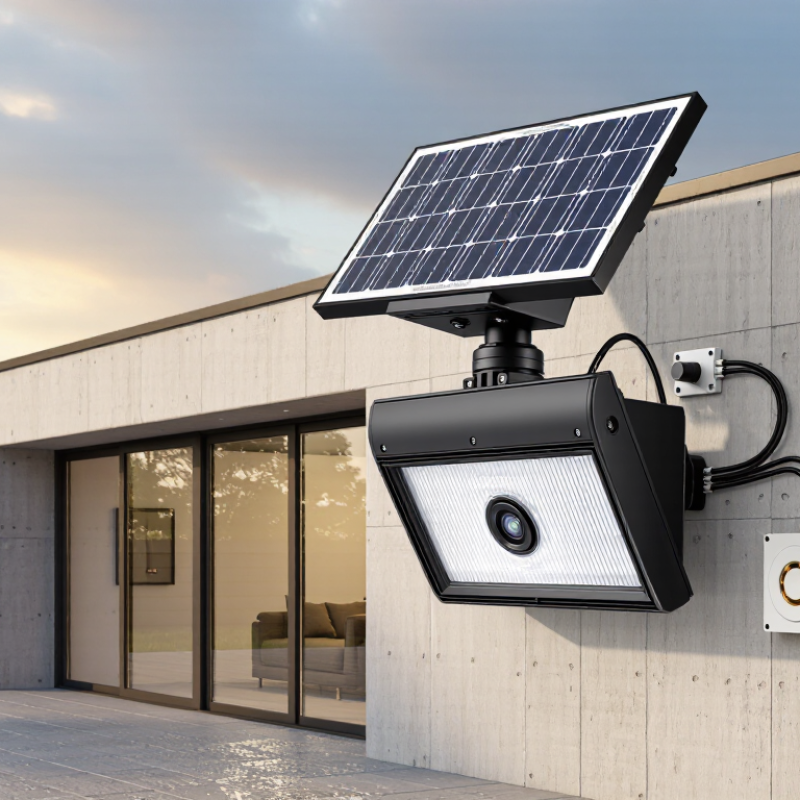
A solar-powered security monitor light combines a photovoltaic panel, rechargeable battery, LED lamp, motion sensor, and monitoring device. Depending on the design, that device may capture video or send alerts over a wireless connection. During daylight, the panel charges the battery; after dark, detected movement can trigger illumination and monitoring. No trenching is needed. But dependable operation still depends on sunlight, battery capacity, and placement.
The technology sits within a rapidly growing solar sector. IEA PVPS’s Trends in Photovoltaic Applications 2024 report estimated that global solar photovoltaic capacity exceeded 1.6 terawatts by the end of 2023, following about 447 gigawatts of new installations that year. That figure describes the wider PV market, not security lights specifically. For a light, check panel output, battery capacity, detection range, and how recordings are stored. A sunny-day test alone can mislead; shaded winter afternoons may tell a different story. Small detail. Big difference.
Tips: Aim the panel toward open sky, away from eaves and tree shade. Test motion detection after dusk, then review battery performance over several cloudy days. A camera without a stable connection may not send alerts reliably.
China Top Solar-Powered Security Monitor Light Manufacturer? What Is a Solar-Powered Security Monitor Light?
This chart estimates how long a security light and monitoring system could run from a 12.8 V, 10 Ah battery. Estimates assume 80% of the battery’s nominal energy is usable and do not account for conversion losses.
Estimated runtime is calculated as usable battery energy (12.8 V × 10 Ah × 80% = 102.4 Wh) divided by average power consumption.
How Solar Security Monitor Lights Work
A solar security monitor light turns sunlight into stored electrical energy, then releases it when darkness or movement triggers the control system. The photovoltaic panel produces direct current during daylight. A charge controller regulates battery charging and helps prevent overcharging. At dusk, a light sensor enables standby mode; when its passive infrared sensor detects changing heat patterns, the controller raises LED output. The detection zone matters. Aiming toward warm walls or passing branches can cause unwanted activation.
Battery capacity, panel size, and daily sunlight determine how reliably the light works overnight. The IEA PVPS Snapshot of Global PV Markets 2024 reported at least 407 GW of new solar capacity installed worldwide in 2023, showing the technology’s growing scale, though small lighting systems face different conditions. A 2013 review by Jordan and Kurtz in Progress in Photovoltaics found median photovoltaic degradation near 0.5% per year across studied systems; this is not a performance guarantee for a compact light. Dust, shade, cold weather, and battery aging can still reduce runtime. A practical check: inspect the panel after several cloudy days, not just one sunny afternoon. Solar operation is convenient, but placement is easy to underestimate.
Key Features of Leading Chinese Manufacturers
Leading Chinese manufacturers distinguish themselves through system design, not just panel wattage. The IEA PVPS Trends in Photovoltaic Applications 2024 report estimates global installed solar capacity reached about 1.6 terawatts by the end of 2023. That scale makes dependable components and transparent testing important. Look for documented panel output, battery capacity, charging performance, and runtime under low-sun conditions. Ask how runtime changes when a camera streams continuously or motion triggers frequent recording. Numbers need context. A stated battery capacity alone cannot show how long a light will operate through cloudy days.
Optics and controls matter at the gate, loading bay, or garden path. A well-aimed beam can illuminate faces and vehicle plates without flooding neighboring windows. Check sensor range, adjustable brightness, dusk-to-dawn settings, and the stated ingress-protection rating for outdoor exposure. Ask for test methods and sample reports, rather than relying on promotional claims. Reputable suppliers should explain warranty terms, battery replacement, and how performance is measured. Details matter. One caution: laboratory results may not match a shaded winter installation, so request realistic operating assumptions before comparing offers. A clear specification sheet is useful, but field feedback and repeatable quality checks make the difference.
Manufacturing, Testing, and Quality Standards
China’s solar-powered security monitor lights need more than a high-output panel. Careful manufacturing determines whether they keep working through cloudy days and wet nights. IEA PVPS reported that global cumulative solar capacity exceeded 1.6 terawatts by the end of 2023. That growth makes dependable components more important, not less. Small details matter.
At the factory, workers should check panel connections, battery polarity, seals, and sensor alignment. Testing can include charging under controlled light, runtime checks after a full charge, and motion-trigger trials at different distances. IEC 61215 provides design qualification and type-testing procedures for photovoltaic modules. IEC 60529 defines enclosure ingress-protection ratings. These standards inform component and housing checks; they do not, by themselves, verify the complete light.
A quality program should also record results by production batch, rather than relying on a single sample. Where rechargeable lithium batteries are used, relevant safety testing should match the cell and product design. Heat, rain simulation, and repeated charge-discharge cycles can reveal weak seals or unstable output. One limitation remains: a short factory test cannot fully reproduce years of dust, shade, and temperature swings. I would treat any claimed service life cautiously unless its test conditions are clearly stated.
How to Select a Supplier for Your Project
China Top Solar Powered Security Monitor Light Manufacturer?
How to Select a Supplier for Your Project
Choosing a supplier starts with your site, not a catalogue. Note how many hours the light must operate, how often monitoring is needed, and whether winter shade limits solar charging. Ask for panel output, battery capacity, and realistic operating-time estimates under your conditions. A bright sample in a sunny showroom proves little. Request test data and clarify how performance changes after cloudy days.
Check the monitor’s image quality, detection range, storage options, and remote access requirements. Then review the housing’s weather-resistance rating and how cables, seals, and mounting brackets are finished. Ask whether the supplier can provide a sample, inspection records, spare parts, and clear warranty terms. Good answers should be specific, not just “high quality.” No datasheet answers everything. A sample installed outdoors may reveal glare, slow alerts, or awkward setup that product photos miss. Compare suppliers by how they handle these questions and document changes, not by price alone. I would still leave room for trial and error; project conditions rarely match the brochure exactly.
China Top Solar Powered Security Monitor Light Manufacturer? - How to Select a Supplier for Your Project
| Selection dimension | What to assess | Practical project benchmark | Evidence to request |
|---|---|---|---|
| Product and application fit | Confirm whether the supplier can provide the required combination of solar lighting, security monitoring, motion detection, recording, and remote access. | Match the product configuration to the site’s coverage area, mounting height, surveillance requirements, and local network availability. | Product specifications, system diagram, sample installation plan, and a live demonstration of the required functions. |
| Solar and battery sizing | Check panel output, battery chemistry and capacity, charging controls, and expected energy use from the light and monitoring equipment. | Request an autonomy calculation based on operating hours, local sunlight conditions, seasonal variation, and expected cloudy days. There is no single battery or panel size suitable for every site. | Load calculation, battery datasheet, solar-panel datasheet, and stated assumptions for daily energy use and backup duration. |
| Lighting performance | Assess measured light output, beam distribution, color temperature, dimming, and motion-triggered lighting behavior. | Compare photometric data against the required illumination and coverage at the actual mounting height; do not select by wattage alone. | IES or equivalent photometric file, test report, and a lighting layout for the project area. |
| Camera and monitoring capability | Verify resolution, field of view, night performance, detection features, recording method, and remote viewing compatibility. | Confirm that the camera provides usable images at the required distance and that recording and alerts work with the site’s connectivity and storage plan. | Camera datasheet, sample day-and-night footage, storage details, and a demonstration using the proposed configuration. |
| Weather and impact protection | Check enclosure protection, corrosion resistance, seals, cable entries, and suitability for the installation environment. | For outdoor equipment, verify the declared IP rating under IEC 60529; IP65 indicates dust-tight protection and protection against water jets under the standard’s test conditions. Select any impact rating according to site risk. | Test reports for the quoted model, enclosure drawings, and details of materials and corrosion protection. |
| Operating conditions | Review the specified operating and storage temperature ranges for the complete system, including the battery and camera. | Ensure the stated range covers expected local temperatures and seasonal exposure; the system’s overall limits may be determined by its most temperature-sensitive component. | Datasheets for each major component and written confirmation of any derating at temperature extremes. |
| Standards and compliance | Check which safety, electromagnetic compatibility, radio, and market-specific requirements apply to the destination country. | Require documentation relevant to the destination market and exact product configuration. A certificate for a different model or component may not demonstrate compliance for the offered system. | Applicable declarations, certificates, and test reports identifying the model and issuing laboratory. |
| Factory and quality controls | Establish whether the supplier manufactures the product, assembles it, or sources components, and how incoming and final inspections are managed. | Review quality-control steps for batteries, solar panels, lighting, camera functions, sealing, and finished-system operation. | Factory audit information, inspection checklist, sample production records, and a pre-shipment inspection procedure. |
| Customization and integration | Assess available mounting options, cable routing, software settings, connectivity choices, and integration with existing security systems. | Confirm technical compatibility before placing an order, particularly for network protocols, mobile access, storage, and any third-party system interfaces. | Interface specifications, compatibility list, configuration proposal, and written confirmation of included customization. |
| Sample and validation plan | Test a representative sample under conditions similar to the intended installation. | Evaluate charging, backup runtime, lighting response, camera footage, connectivity, and weather sealing before approving bulk production. | Sample test plan, acceptance criteria, test results, and a documented process for handling failures. |
| Production capacity and lead time | Check the supplier’s ability to meet the project quantity, delivery schedule, and any staged shipment requirements. | Base the schedule on confirmed component availability, production time, inspection, and shipping—not on an unverified verbal estimate. | Written production schedule, order milestones, capacity confirmation, and agreed delay notification process. |
| Warranty and after-sales support | Review warranty coverage separately for the battery, solar panel, lighting, camera, and other system components. | Confirm warranty period, exclusions, replacement process, technical support availability, and access to spare parts in writing. | Warranty terms, support response process, spare-parts list, and troubleshooting documentation. |
| Total project cost | Compare the complete delivered system, not just the unit price. | Include accessories, mounting hardware, packaging, testing, shipping, duties, installation, connectivity, and expected maintenance in the cost comparison. | Itemized quotation, Incoterm, payment schedule, packing details, and any recurring service or data costs. |
| Contract and acceptance terms | Define what is being supplied, how conformity is checked, and what happens if the delivered goods do not meet the agreed specification. | Use a written specification with model identifiers, quantities, test criteria, delivery terms, and a process for resolving nonconformities. | Pro forma invoice or contract, approved drawings, signed specification, and inspection and acceptance clauses. |
| Supplier comparison | Score each candidate against the same technical and commercial criteria. | Suggested weighting: technical fit 30%, verified quality and compliance 20%, solar and battery design 15%, service and warranty 15%, delivery capability 10%, and total cost 10%. Adjust the weighting to suit project priorities. | Completed comparison matrix with evidence references, open questions, and a record of sample or factory evaluations. |
FAQS
It combines a solar panel, rechargeable battery, LED lamp, motion sensor, and monitoring device.
Daylight charges the battery. At night, detected movement can trigger illumination and monitoring.
It may still operate, but shade and cloudy weather can reduce charging. Winter afternoons can be revealing.
Aim it toward open sky, away from eaves and tree shade. Small detail. Big difference.
Test it after dusk at different distances. Then check whether movement triggers the light and monitoring device.
A camera without a stable connection may not send alerts reliably. Check the connection where you plan to install it.
Look for checks of panel connections, battery polarity, seals, and sensor alignment. Runtime and motion-trigger tests are useful too.
No. Short tests cannot fully reproduce years of dust, shade, rain, and temperature changes. I would treat vague lifespan claims cautiously.
Heat exposure, simulated rain, and repeated charging cycles may reveal weak seals or unstable output. One sample may not tell the whole story.
Conclusion
A Solar Powered Security Monitor Light combines solar energy, motion detection, illumination, and monitoring functions in one outdoor security solution. Its solar panel collects energy during daylight and stores it in a rechargeable battery for use after dark. When motion is detected, the unit can activate its light and monitoring features, helping provide visibility around entrances, paths, and other outdoor areas while reducing reliance on wired power.
Leading Chinese manufacturers may offer different designs, materials, battery capacities, detection ranges, and control options to suit varied project needs. Reliable production involves careful component selection, assembly checks, and testing of charging performance, lighting, sensors, weather resistance, and overall operation. When selecting a supplier, buyers should compare product specifications, quality-control practices, customization capabilities, communication, and after-sales support. Matching these factors to the installation environment and project requirements can help ensure the chosen solution is practical, durable, and suited to its intended use.

Blog Tags: