Insights & Articles

Solar Lighting Blog & News

Latest news, technical guides, and expert perspectives on smart solar street lights, off-grid infrastructure, and clean energy technology.

0%

China’s highway lighting sector is changing quickly. Solar-powered systems now support safer travel, lower grid dependence, and reduced maintenance along remote roads. Yet product quality varies widely. A strong factory must prove more than attractive specifications.

This guide introduces China’s Top 10 Highway Solar Street Light Manufacturers. It examines their engineering experience, production capacity, testing procedures, and after-sales support. It also considers practical details, including battery performance during cloudy weeks, corrosion resistance near coastal highways, and lighting consistency across wide road surfaces. These details matter at midnight.

Solar lighting specialist Dr. Steven F. M. Hollands has emphasized, “Good solar design begins with understanding the site, not simply choosing a larger panel.” This principle remains important for highway projects. A powerful lamp can still fail when shading, traffic patterns, temperature, and maintenance access are ignored.

The manufacturers discussed here serve different project needs. Some focus on integrated all-in-one units. Others provide split systems, smart controls, lithium batteries, or customized poles. Their strengths are not identical. Neither are their limitations.

Readers should treat rankings as a practical starting point, not an absolute verdict. A supplier may perform well in one climate and poorly in another. Certification documents also require careful verification. Product brochures can look impressive. Field records are more convincing.

This overview uses an experience-based lens. It values measurable performance, transparent communication, and dependable delivery. The goal is simple: help buyers compare China’s Highway Solar Street Light manufacturers with clearer expectations and fewer costly assumptions.
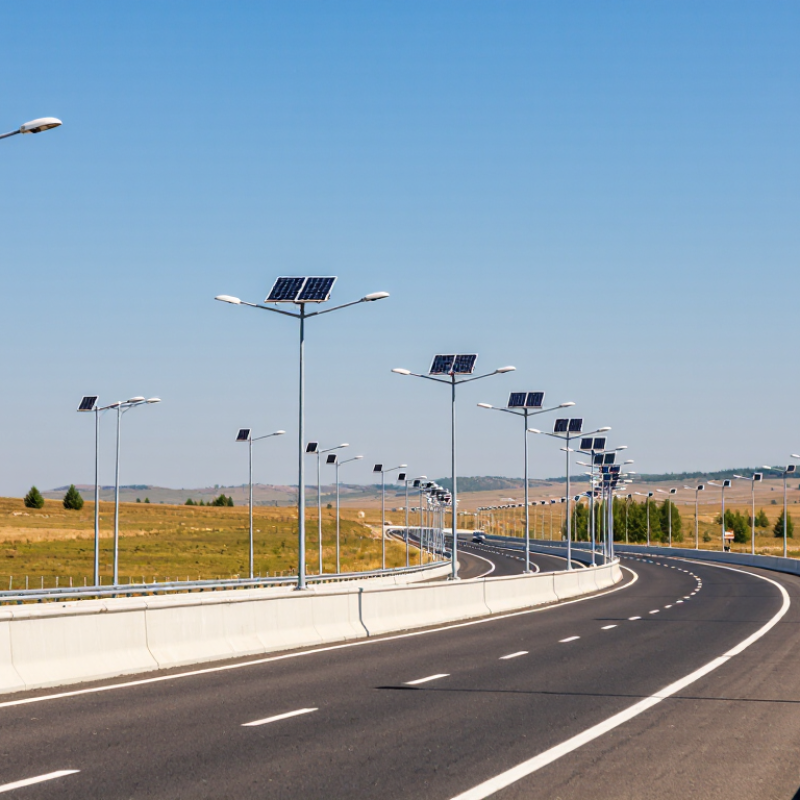
China Top 10 Highway Solar Street Light Manufacturers?

What Are Highway Solar Street Lights?

Highway solar street lights are standalone lighting systems that use sunlight to illuminate roads, ramps, service lanes, and roadside facilities. Each unit normally includes a photovoltaic panel, LED lamp, rechargeable battery, controller, and galvanized steel pole. During daylight, the panel converts sunlight into electricity. The battery stores energy for nighttime operation.

Unlike ordinary grid-connected lamps, these systems do not require continuous underground cables. This can reduce trenching work in remote areas and simplify installation near unfinished highways. However, performance depends heavily on local conditions. Dust, winter clouds, tree shadows, and incorrect panel angles can reduce charging efficiency. They are not maintenance-free.

In practical highway projects, engineers usually check road width, traffic speed, mounting height, wind pressure, drainage, and nighttime brightness before selecting equipment. A quality design should provide stable illumination without creating glare for drivers. Battery capacity also matters during several cloudy nights. Lithium iron phosphate batteries are often considered for their longer service life and thermal stability, but their cost can be higher.

Field inspections should measure actual illuminance, battery voltage, panel cleanliness, and pole corrosion. A lamp that looks bright beside a warehouse may perform poorly on an open highway. This detail is easy to miss. Weather data should support the design, not replace on-site testing. Some projects still need backup power or wider pole spacing after installation.

How to Evaluate Chinese Highway Solar Street Light Manufacturers

Evaluating Chinese highway solar street light manufacturers requires more than comparing catalog prices. A polished factory tour can mislead. Ask for production records, testing procedures, and recent highway project references. During a site visit, inspect battery assembly, controller protection, welding quality, and cable sealing. Request photometric files showing illumination levels across the road surface. The supplier should explain its design assumptions clearly.

Technical evidence matters. Check whether lamps have suitable ingress and corrosion protection for local weather. Review battery capacity, cycle testing, operating temperature, and expected service life. Ask for independent test reports, not only internal certificates. Verify that the listed standards match your project requirements and destination regulations. Small details matter. Confirm spare parts, firmware access, packaging strength, and installation guidance. A low quotation may hide weak batteries or expensive maintenance.

Reliability also depends on communication after delivery. Contact previous customers and ask about failures after heavy rain, dust, or winter nights. Read the warranty carefully, including response times and excluded components. Check whether the manufacturer provides lighting simulations, installation training, and replacement procedures. I once underestimated the value of clear wiring labels; that mistake delayed field repairs. Manufacturers should admit design limits instead of promising perfect performance. Factory capacity, quality control records, and consistent technical answers reveal more than impressive brochures.

China Top 10 Highway Solar Street Light Manufacturers? - How to Evaluate Chinese Highway Solar Street Light Manufacturers

No. Evaluation Dimension Recommended Technical Benchmark Evidence to Request Weight Assessment
1 Roadway Lighting Performance Photometric design should be based on the road classification, target illuminance or luminance, uniformity, glare control, and mounting geometry required by the project. IES/LDT photometric files, lighting simulation, pole-height calculation, road-width assumptions, and an independent photometric test report. 20% Critical
2 Solar Resource and System Sizing The photovoltaic array and battery should be sized with location-specific peak-sun-hour data, seasonal irradiation, panel tilt, system losses, and the required autonomy period. Monthly energy-balance calculation, solar database source, panel datasheet, battery-capacity calculation, and winter operating assumptions. 15% Critical
3 Battery Technology and Protection For lithium-based systems, verify the cell chemistry, battery-management system, low-temperature charging protection, overcharge protection, short-circuit protection, and thermal safeguards. Battery datasheet, BMS specifications, UN 38.3 transport test, IEC 62133-2 or equivalent safety documentation, and cycle-life test conditions. 13% Critical
4 LED Efficiency and Light Quality Evaluate delivered luminaire performance rather than LED-chip claims. A practical comparison should include system efficacy, correlated color temperature, color rendering, lumen maintenance, and thermal design. LM-79 test report, LM-80/TM-21 documents where applicable, LED-bin information, thermal test data, and complete luminaire lumen output. 10% High
5 Weather and Impact Resistance Outdoor highway equipment should normally be evaluated for at least IP66 enclosure protection and suitable mechanical impact resistance, with the final level determined by the site environment. IP test report based on IEC 60529, IK test report based on IEC 62262, corrosion-resistance information, and enclosure-material specifications. 10% High
6 Electrical and Product Compliance The product should be tested against applicable safety and performance requirements, including LED-luminaire standards and market-specific electromagnetic-compatibility requirements. Applicable IEC 60598-1 and IEC 60598-2-3 test reports, EMC reports, declaration of conformity, and product traceability records. 10% High
7 Mechanical Design and Wind Resistance The luminaire, solar panel, bracket, and battery enclosure should be checked for local wind loads, mounting torque, vibration, structural strength, and maintenance access. Structural calculation, wind-load assumptions, bracket drawings, material grades, fastener specifications, and vibration or mechanical-test results. 8% High
8 Controller, Dimming, and Monitoring The controller should support programmable dimming, dusk-to-dawn operation, battery protection, fault indication, and optional remote monitoring without compromising basic offline operation. Controller manual, dimming schedule, communication protocol, sample monitoring dashboard, fault logs, and surge-protection specifications. 6% Medium
9 Manufacturing Quality and Traceability Prefer documented incoming inspection, process control, final inspection, serial-number traceability, calibrated test equipment, and a quality-management system such as ISO 9001. Current ISO 9001 certificate, factory-audit report, quality-control plan, inspection records, calibration certificates, and nonconformance procedure. 5% Medium
10 Warranty, Service, and Total Cost Compare warranty duration, exclusions, replacement procedures, spare-parts availability, delivery capability, installation support, and lifecycle cost rather than purchase price alone. Signed warranty terms, spare-parts list, response-time commitment, reference-project verification, delivery schedule, and five-to-ten-year cost model. 3% Medium
Total Evaluation Weight 100% Weighted Score
Recommended Selection Method: Score each supplier from 1 to 5 for every dimension, multiply the score by the stated weight, and verify all critical documents before placing a production order. Technical compliance should be confirmed against the destination country’s road-lighting, electrical, EMC, safety, and construction requirements.

Profiles of China’s Top 10 Highway Solar Street Light Manufacturers

China’s highway solar street light sector includes manufacturers with different strengths, production scales, and engineering approaches. This profile compares ten leading manufacturers through practical criteria, not marketing claims. The review considers solar module quality, battery safety, lighting performance, and after-sales support.

Several manufacturers focus on high-output systems for wide highway lanes. Their products commonly use 30 to 80-watt LED modules, six to twelve-meter poles, and lithium iron phosphate batteries. Others specialize in compact units for service roads, toll areas, and rural connections. Reliable suppliers provide photometric reports, battery cycle data, IP66 protection tests, and clear installation drawings. These documents make technical comparisons easier.

Factory experience matters during harsh weather. Strong suppliers test systems through thermal cycling, rain exposure, vibration, and simulated low-sunlight periods. A useful design should provide roughly ten to twelve hours of lighting after a full charge, with backup capacity for cloudy days. Yet specifications do not tell everything. Some published figures may reflect ideal laboratory conditions, not busy highways. Field maintenance can also reveal weak connectors, loose brackets, or slow replacement support. That is why these ten profiles should be read with project evidence, sample testing, and local climate data. No manufacturer is perfect. Even a well-designed system may need a larger battery in northern winters or stronger corrosion protection near coastal roads.

China Top 10 Highway Solar Street Light Manufacturers

This chart summarizes commonly reported product capabilities across ten representative Chinese highway solar street light manufacturer profiles. The comparison focuses on practical highway-lighting features rather than company names or brand rankings. Counts indicate how many profiles publicly present each capability in their product or solution descriptions.

Comparing Products, Technologies, Certifications, and Services

Comparing China’s top 10 highway solar street light manufacturers requires more than checking price or advertised wattage. Examine real lighting output, battery capacity, solar panel efficiency, and night-time autonomy. A highway project may need six to twelve hours of reliable illumination, even after cloudy weather. Monocrystalline panels, LiFePO4 batteries, MPPT controllers, motion dimming, and remote monitoring can improve performance. However, technology should match local sunlight, traffic flow, temperature, and pole spacing.

Certifications also deserve careful verification. Look for ISO 9001 quality systems, CE and RoHS documentation, relevant IEC test reports, and tested IP and IK ratings. Ask whether reports identify the exact model, battery, and controller. A certificate for a similar product proves little. Service quality matters equally. Reliable manufacturers provide photometric layouts, sample testing, installation drawings, warranty terms, spare parts, and responsive technical support. Site experience is valuable; coastal roads need stronger corrosion protection, while northern regions require cold-weather battery testing. A perfect ranking is difficult. Factory visits and independent tests may reveal differences that catalogs hide.

Tips: Request a complete datasheet, not only lumen claims. Compare two or three samples under identical conditions. Check battery replacement procedures and warranty exclusions. Ask for delivery records and reference projects. Do not ignore small details, such as connector sealing or cable length. These often cause field problems.

How to Choose the Right Manufacturer for a Highway Project

China Top 10 Highway Solar Street Light Manufacturers?
How to Choose the Right Manufacturer for a Highway Project

Choosing a highway lighting manufacturer requires more than comparing product prices. Start with verified project experience in similar climates, traffic conditions, and road layouts. Ask for lighting calculations, not only product brochures. The design should show illumination levels, spacing, glare control, and shadow coverage. Request test reports for the panel, battery, controller, and LED module. Independent reports are more valuable than unverified claims.

Check whether the manufacturer understands local wind loads, temperature changes, dust, humidity, and salt exposure. A highway pole may face strong gusts and vibration for years. Look for suitable corrosion protection, sealed electrical enclosures, and clear IP and impact ratings. Battery cycle life deserves close attention. A bright lamp is useless after several cloudy nights. The numbers matter.

Visit the factory when possible. Review assembly areas, quality records, aging tests, and spare-part storage. Ask how faults are diagnosed after installation. Reliable suppliers provide drawings, installation guidance, warranty terms, and responsive technical support. A small pilot section can reveal problems with shadows, charging time, or maintenance access before full deployment. One weak point is often overlooked: suppliers may present ideal laboratory data, while real roads are messier. Require field monitoring during cloudy and rainy periods, then adjust the design before approving the full highway order.

FAQS

What are highway solar street lights?

They are standalone lighting systems for highways, ramps, service lanes, and roadside areas. Each unit uses a solar panel, LED lamp, battery, controller, and steel pole. The panel charges the battery during daylight. The stored energy powers the lamp at night. No continuous underground cable is required.

Do solar highway lights work during cloudy weather?

They can, but performance may decrease after several cloudy days. Battery capacity and local sunlight conditions are important. Engineers should study winter clouds, dust, tree shadows, and panel angles. Backup power may still be necessary. Not always.

What should engineers check before selecting a system?

They should review road width, traffic speed, pole height, wind pressure, drainage, and required brightness. Glare must not disturb drivers. They should also examine nighttime lighting patterns across the road surface. A bright lamp near a warehouse proves little.

Are highway solar street lights maintenance-free?

No. Panels need cleaning when dust reduces charging efficiency. Inspections should measure brightness, battery voltage, cable condition, and pole corrosion. Workers may also find loose brackets or damaged connectors. Maintenance is easy to underestimate.

How can buyers evaluate a manufacturer?

Buyers should request production records, testing procedures, recent highway references, and independent test reports. They can inspect battery assembly, welding, controller protection, and cable sealing. A polished factory tour is not enough. Field evidence wins.

Which technical documents should a supplier provide?

Useful documents include photometric files, lighting simulations, battery cycle data, installation drawings, and protection-test records. Buyers should check ingress and corrosion protection for local weather. Standards must match project requirements and destination regulations. Small details matter.

What battery features are important for highway lighting?

Buyers should review battery capacity, cycle testing, operating temperature, and expected service life. Lithium iron phosphate batteries may offer thermal stability and longer service life. Their higher cost needs careful evaluation. A larger battery may help in northern winters.

Why should buyers contact previous customers?

Previous customers can describe failures after heavy rain, dust, or long winter nights. They can also explain response times and replacement support. Warranty exclusions deserve close attention. I once underestimated wiring labels. Field repairs were delayed.

Conclusion

This article provides a practical guide to China’s top Highway Solar Street Light manufacturers and explains how their solutions support safe, energy-efficient road illumination. It begins by defining highway solar street lights, including their solar panels, batteries, LED fixtures, controllers, and intelligent monitoring features. It then outlines the key criteria for evaluating manufacturers, such as product reliability, lighting performance, production capacity, quality control, certifications, customization options, warranty terms, and after-sales support.

The article also presents profiles of ten leading manufacturers without focusing on brand promotion, highlighting their general strengths, technologies, product ranges, and service capabilities. A comparison of products, certifications, installation support, and maintenance services helps buyers understand the differences between suppliers. Finally, it offers a structured method for choosing the right manufacturer according to road conditions, climate, traffic requirements, project budget, local standards, delivery schedules, and long-term operating costs.

Amelia

Amelia

Amelia is a dedicated marketing professional with a strong understanding of product strategy, customer needs, and the evolving expectations of modern businesses. As a regular contributor to the company’s professional blog, she creates clear, practical, and insightful articles that help readers......