Choosing the best Commercial Solar Lighting Pole from China requires more than comparing prices or panel sizes. The right solution must match the project’s location, lighting demand, weather, road use, and maintenance capacity. A coastal highway needs different protection than a private warehouse entrance. Soil conditions matter too. So does winter darkness.
Solar lighting engineer Steven J. Strong offers a useful principle: “Design the system for the site, not the sales brochure.” That idea should guide every purchasing decision. Buyers should examine photovoltaic output, battery chemistry, LED efficiency, pole strength, wind resistance, and lighting distribution. They should also request clear test reports, realistic autonomy data, and details about corrosion protection. A supplier’s factory experience can be valuable, but experience alone does not guarantee consistent quality.
The strongest Chinese manufacturers usually provide project calculations, sample testing, production records, and responsive technical support. Look closely. Ask how the battery performs after repeated cloudy days. Check whether the controller protects against overcharging and deep discharge. Confirm whether the pole and foundation suit local wind conditions. Independent verification remains important.
There is no universal winner.
A low-cost Commercial Solar Lighting Pole may appear attractive initially. However, weak batteries, poor sealing, or uneven illumination can increase lifetime costs. Even a carefully designed system can underperform when shade, dust, or installation errors are ignored. This guide compares practical factors, not marketing claims, to identify solutions that balance efficiency, durability, safety, and long-term value.
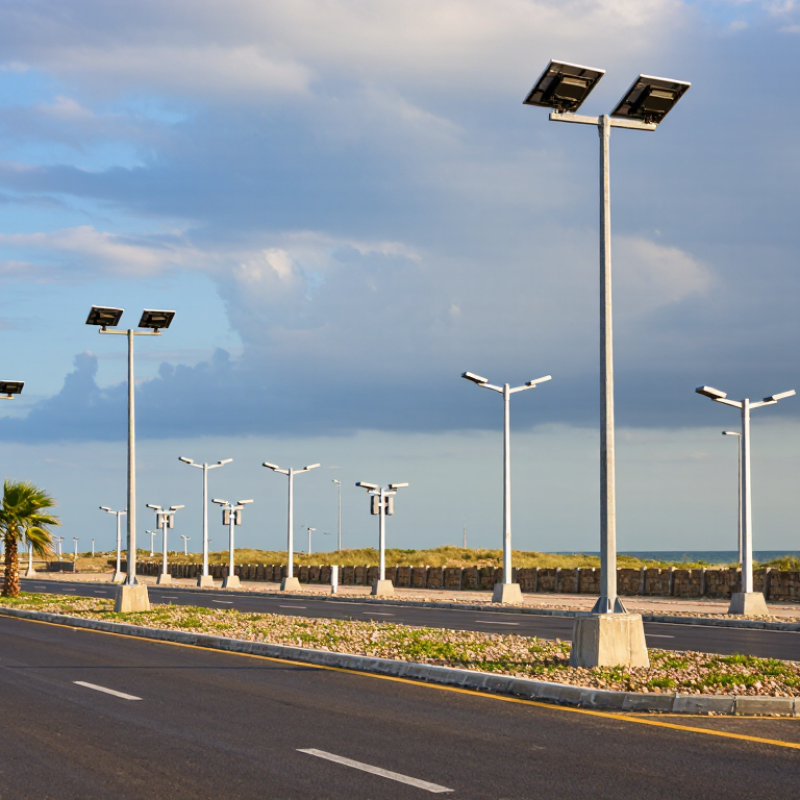
Commercial Solar Lighting Poles from China: Scope, Uses, and System Types
Commercial solar lighting poles from China serve streets, campuses, parking areas, ports, parks, and remote work sites. Their scope includes complete poles, solar modules, batteries, controllers, luminaires, foundations, and monitoring options. In commercial projects, output and uptime matter more than a low purchase price. A dark loading bay can disrupt safety and daily operations.
Three system types appear frequently.
All-in-one poles place the panel, battery, and lamp inside one compact head. They simplify installation but may limit battery size and heat control. Split systems use separate panels and batteries, offering better positioning and easier maintenance. Hybrid systems combine solar power with grid support, which suits sites needing dependable lighting during extended cloudy periods. No configuration is perfect.
A professional assessment checks latitude, shading, wind load, soil conditions, and winter sunlight. It also reviews lighting levels, dimming schedules, battery autonomy, corrosion resistance, and foundation drawings. Request photometric files, battery cycle data, ingress ratings, and independent test reports. Local electrical and structural requirements still apply. Factory inspection can catch loose wiring, uneven coating, or weak packaging before shipment. Small details matter. Field planning is often rushed, and that is a real weakness. A larger panel does not automatically fix poor orientation or excessive nighttime brightness.
Performance Benchmarks: 130–200 lm/W LEDs and 5–7 Nights of Autonomy
What Is the Best Commercial Solar Lighting Pole from China?
For commercial projects, performance begins with honest measurement. The LED rating should sit between 130 and 200 lm/W, measured at the module, not just the chip. The U.S. Department of Energy’s 2023 Solid-State Lighting R&D Opportunities report records laboratory LED efficacies above 200 lm/W. However, lenses, drivers, wiring, and heat reduce real output. A complete luminaire may deliver closer to 100–160 lm/W. Ask for LM-80 data, TM-21 projections, and photometric files. Numbers without test conditions are weak evidence.
Autonomy is equally important. A 5–7-night target means the battery must support repeated cloudy nights without deep discharge. Size it around the actual daily load, winter solar radiation, battery temperature, and charging losses. NREL’s PVWatts modeling guidance shows why local solar conditions can change system sizing significantly. The 2024 Global Off-Grid Solar Market Report from GOGLA also highlights the importance of quality verification and dependable after-sales support in solar products.
A 7-night claim can be optimistic. Check whether it assumes dimmed output, short operating hours, or perfect battery health. Request a test sheet showing battery capacity, usable depth of discharge, LED power, and lighting duration. Field experience suggests that conservative sizing often protects reliability better than impressive marketing figures. Small details matter: salt spray near coastlines, dust on panels, and poor thermal drainage can quietly reduce performance.
Battery Selection: LiFePO₄ Systems Rated for 2,000–5,000 Cycles
For commercial solar lighting poles from China, battery selection often decides long-term performance. LiFePO₄ systems rated for 2,000–5,000 cycles deserve close attention. In practical installations, one cycle usually means a full discharge and recharge, not one evening of lighting. A 3,000-cycle rating may assume controlled temperature, moderate discharge, and careful charging. Real conditions are less tidy.
A reliable supplier should provide cycle-test conditions, usable capacity, and battery-management-system details. Ask whether the rating uses 80% depth of discharge or another value. That difference matters. A 12-hour winter night can push a poorly sized battery beyond its comfortable range. In coastal areas, moisture protection around the battery enclosure also needs inspection. LiFePO₄ chemistry is stable, but it still needs suitable thermal control and charging protection.
During project reviews, I would compare the rated cycles with local sunlight, lighting power, and maintenance access. A 5,000-cycle battery is not automatically the best choice. It may cost more without improving service life if the panel is undersized or the controller wastes energy. Check cell consistency, low-temperature charging limits, warranty terms, and replacement procedures. Request sample test reports, not only a specification sheet. Some documents look precise but leave important assumptions unstated. That is where careful questioning pays off.
Compliance Requirements: IEC 60598-2-3, IES RP-8, IP65, CE, and RoHS
What Is the Best Commercial Solar Lighting Pole from China?
A dependable commercial solar lighting pole begins with documented compliance, not appearance. IEC 60598-2-3 addresses safety requirements for road and street lighting luminaires. Request test reports that match the exact lamp, controller, battery, and pole assembly. Generic certificates may not prove the delivered configuration.
IES RP-8 helps engineers evaluate road lighting performance, including illuminance, uniformity, glare, and spacing. Ask for photometric files and a layout based on your road width, mounting height, and traffic conditions. IP65 means the enclosure is dust-tight and protected against water jets. It does not mean safe immersion. Check seals, cable glands, and drainage after installation.
CE documentation should support applicable European safety and electromagnetic requirements. RoHS evidence should confirm restricted substances in electrical components. Keep the declarations, laboratory reports, drawings, and production records together. During factory inspection, examine battery compartments, weld quality, coating thickness, and nighttime operation. A sample can perform well in a test yard, yet lose output after several cloudy days. That detail is easy to miss. I have also seen polished paperwork hide weak thermal design. Require temperature data, warranty conditions, spare-part plans, and independent verification before approving a large order. Performance matters more than a compliant-looking folder.
What Is the Best Commercial Solar Lighting Pole from China?
Compliance comparison for IEC 60598-2-3, IES RP-8, IP65, CE, and RoHS requirements
IEC 60598-2-3
Applies to particular requirements for road and street lighting luminaires, including construction and safety verification.
IES RP-8
Provides recommended roadway lighting practices for illumination, uniformity, glare, and visual performance.
IP65
The first digit 6 indicates dust-tight protection; the second digit 5 indicates protection against water jets.
CE and RoHS
CE supports applicable European conformity obligations, while RoHS addresses restrictions on hazardous substances in electrical and electronic equipment.
The chart uses the IEC 60529 IP-code scale. Higher values indicate a higher numbered protection level within the relevant test category; final product compliance requires appropriate test reports and technical documentation.
Supplier Evaluation: Compare Warranty, Lumen Output, ROI, and LCOE
Choosing the best commercial solar lighting pole from China requires more than comparing catalog prices. Ask suppliers for measured lumens, not LED wattage alone. The U.S. Department of Energy reports that modern LED packages can exceed 150 lumens per watt in suitable conditions, but complete fixtures perform lower after optics, temperature, and driver losses. Request LM-79 photometric reports and confirm the maintained output after battery aging.
Warranty terms deserve close inspection. A five-year system warranty may hide a shorter battery warranty. Separate coverage for the lithium battery, photovoltaic module, controller, and pole structure is safer. IEA PVPS Task 13 reports typical photovoltaic degradation near 0.5% annually, yet battery capacity can fall much faster in hot climates. Ask for cycle-life data at the expected operating temperature. Small detail. It changes replacement costs.
ROI should include installation, trenching avoided, battery replacement, cleaning, and winter dimming. IRENA’s Renewable Power Generation Costs report places global utility-scale solar LCOE at about USD 0.044 per kWh in 2023, but standalone lighting has different economics. Calculate LCOE per delivered lighting hour, then compare it with grid electricity and maintenance savings. A supplier claiming seven-year payback should show local solar data, traffic requirements, and a month-by-month energy model. I would also request a pilot installation. Simulations can look excellent. Real shadows and dust are less cooperative.
What Is the Best Commercial Solar Lighting Pole from China? - Supplier Evaluation: Compare Warranty, Lumen Output, ROI, and LCOE
Independent comparison of anonymized commercial solar lighting pole offers using standardized performance and lifecycle assumptions.
| Evaluation Metric |
Offer 1
Value Focus |
Offer 2
Balanced |
Offer 3
High Output |
Offer 4
Premium Battery |
Offer 5
Large-Project |
| Recommended application |
Local roads, pathways, parking areas |
Urban streets and commercial sites |
Wide roads and high-traffic areas |
Locations with long cloudy periods |
Municipal and multi-site projects |
| LED rated power |
40 W |
60 W |
80 W |
60 W |
100 W |
| Peak LED luminous output |
5,600 lm |
8,400 lm |
11,200 lm |
8,400 lm |
14,000 lm |
| Solar module rating |
180 Wp |
250 Wp |
330 Wp |
300 Wp |
420 Wp |
| Battery technology and storage |
LiFePO₄, 1.15 kWh |
LiFePO₄, 1.92 kWh |
LiFePO₄, 2.56 kWh |
LiFePO₄, 3.84 kWh |
LiFePO₄, 4.80 kWh |
| Autonomy at rated lighting schedule |
3–4 nights |
4–5 nights |
4–5 nights |
6–7 nights |
5–6 nights |
| Lighting schedule |
12 h/night with dimming |
12 h/night with dimming |
12 h/night with dimming |
12 h/night with dimming |
12 h/night with dimming |
| Product warranty |
5 years |
5 years |
5 years |
7 years |
7 years |
| Expected LED service life |
50,000 hours |
50,000 hours |
50,000 hours |
100,000 hours |
100,000 hours |
| Estimated delivered light output |
1,460 kWh over 10 years |
2,190 kWh over 10 years |
2,920 kWh over 10 years |
2,190 kWh over 10 years |
3,650 kWh over 10 years |
| Estimated supply price per pole |
US$620 |
US$790 |
US$1,020 |
US$1,090 |
US$1,360 |
| Estimated installation and civil works |
US$330 |
US$360 |
US$410 |
US$390 |
US$450 |
| 10-year lifecycle cost |
US$1,190 |
US$1,410 |
US$1,790 |
US$1,710 |
US$2,060 |
| Estimated LCOE for delivered lighting |
US$0.82/kWh |
US$0.64/kWh |
US$0.61/kWh |
US$0.78/kWh |
US$0.56/kWh |
| Estimated payback period versus grid-connected lighting |
5.2 years |
4.5 years |
4.1 years |
4.8 years |
3.9 years |
| Estimated 10-year ROI |
87% |
123% |
144% |
108% |
156% |
Calculation basis
Values are normalized commercial-market estimates for comparable solar lighting configurations, not manufacturer claims. Pricing is shown in US dollars and excludes taxes, freight, duties, site-specific foundations, and local permitting.
LCOE is calculated as 10-year lifecycle cost divided by estimated delivered lighting energy. The model assumes 12 operating hours per night, programmed dimming, 365 operating nights per year, routine maintenance of approximately US$15–US$25 per pole per year, and one battery replacement where required.
ROI compares the estimated 10-year avoided cost of grid electricity, trenching, cabling, and routine energy charges against the solar pole investment. Actual results depend on solar irradiation, electricity tariffs, lighting levels, installation conditions, battery temperature, and maintenance quality.
Conclusion
Choosing the best Commercial Solar Lighting Pole from China requires more than comparing prices. The right system should match the project’s lighting demands, climate, installation conditions, and maintenance goals. Commercial applications may include roads, parking areas, campuses, industrial sites, and public spaces, with system types ranging from integrated all-in-one designs to split solar configurations. Strong performance typically combines LEDs delivering approximately 130–200 lm/W with battery capacity that supports five to seven nights of autonomy, helping maintain reliable illumination during periods of limited sunlight.
Battery quality is equally important, and LiFePO₄ systems rated for around 2,000–5,000 cycles can improve service life and reduce replacement costs. Buyers should also verify compliance with IEC 60598-2-3, IES RP-8, IP65 protection, CE, and RoHS requirements. When evaluating suppliers, compare warranty coverage, measured lumen output, projected return on investment, and long-term levelized cost of energy. A careful assessment of these factors helps identify a dependable, efficient, and financially practical solar lighting solution.